Since I discussed a few fun facts about Spine Chillers: The Beast of Black Pond on my last blog, I thought it might be fun to discuss some of the themes from the series and particularly this story. All of the villains in my stories are based off of primal fears, especially childhood fears. Most of these are things we grow out of when we're older, but some are still part of who we are. And to make this more personal, I'll use myself as the example.
I still have a bad phobia of spiders. I have vague memories of being a child and playing with one (before I knew better) that got in my bed. Most people realize when they lift their front legs up and swipe at your finger that means they're going to bite you, but this is a very vague memory so I have to assume I was very little. Anyway, it bit me and even if I don't have a clear memory of that experience I hate spiders now because I'm afraid of them. As I've gotten older, I've slowly gotten better about the fear and can confront them with a shoe or can of raid, but if one is on the ceiling I tend to stare at it. Honestly, I don't really like to kill them, so I'm hoping one day I get over it enough to take them outside rather than destroy the ones in my house. I can appreciate their beauty from a distance in their own environment.
Another example is the fear of dark water and drowning. I have this phobia too. There is one memory in particular that sticks out in my mind. I was playing in the ocean with my alligator float and somehow, after a wave knocked me off, I got my feet and arms tangled up in the rope used to hold on to the float. I was stuck upside down. I remember thinking I was really going to drown and the burning feeling of being unable to breathe when my granddad saved me. There have also been too many times when something unknown has brushed up against me in the dark water of the ocean, so long story short I don't like going deep enough to swim in the ocean anymore.
Finally, the last fear I can think of that I have is heights. I think this might be from back when I was in high school and was stuck upside down one one of those loop rides at the fair with only a lap strap and foot bar to hold me in. I was like that for probably ten minutes and I felt like at any moment that restraint could snap and that would be the end of me. Dangling like that also gives you a good look at just how flimsy those rides are and that doesn't help things. I don't particularly like roller coasters now and have occasional dreams of falling down the stairs of Longstreet Theater. (For those who don't live in SC Longstreet Theater has a huge, long flight of marble steps all the way down to the street. There would probably be broken bones if you were to roll down all of them.)
Those are my main primal fears, spiders, dark water, and heights. Most of these stem from lack of control over one's environment, and know one feels a lack of control more keenly than a child. In my stories, there are basic primal fears and most of the creatures that attack the children embody one of these archetypal fears. For instance, the wolf spirit is supposed to evoke a fear of large animals. Also, the fact the battle takes place in the main characters head means it also is the embodiment of nightmares and fears that are hidden.
In Spine Chillers: The Beast of Black Pond, the obvious fear is of drowning and death, however there is a little more there. There is also the fear of the unknown. The pond is called Black Pond because the water is so murky and the shadows cast on it are so dark the water itself looks black. The creature within the pond has the impassive, cold nature of water but it also has the wrath of churned water in a storm. The scary thing about the creature is it can travel anywhere where water resides. Duane isn't even safe in his home. The opening scene when he has his "scare" in the pool is foreshadowing for what is to come.
Other fears that are touched on in other novels are fear of the self (as in, fear of what you are capable of), fear of failure, fear of the unknown, fear of the dark, fear of loss, fear of strangers, etc. Look for these primal fears and tell me what you think the three books published so far embody. And since I've shared my fears with you, feel free to share yours here. It might be good inspiration and you might just find your fear in a future book...
Showing posts with label book review. Show all posts
Showing posts with label book review. Show all posts
Wednesday, October 17, 2018

Monday, October 15, 2018
The Beast of Black Pond is available for purchase! Here are some things about it...
Well, Spine Chillers: The Beast of Black Pond is out in e-book form and hard copy on amazon. I'm so exited! I thought you might want to know a few things about this book and the series in general, so I thought I'd write a blog about it. I hope you enjoy it.
First of all, I'd like to tell you a little about this book that you might not know. It was the first book of this series that I wrote. It's gone through quite a few revisions before it became what it is today. When the book started out, the actual "beast" that haunted black pond was a creature known as a "grim." (You might have heard of a "grim" from the Harry Potter series. It actually is based on the legend of "black dog" ghosts or "hellhounds.")
Anyway, the original "beast" in the pond was a spectral dog that dragged unsuspecting victims in to drown them. While I liked the image, it didn't seem to fit. So I used the idea in another story that I began to work on in tandem called Spine Chillers: Big Bad Wolf.
A little off topic, those who have read the story Spine Chillers: Big Bad Wolf know that the actual creature chasing Jane isn't a black dog or wolf but a wendigo. A wendigo is a spirit of someone who was a cannibal when they were alive. It's an Algonquin legend. I did a great deal of research on the subject and tried to stick as close to the legend as possible. The only way I deviated that I know of it is that it originally came to Jane in the form of a spectral wolf. The reason it took the form of a wolf in my book was because it possessed a wolf to continue to hunt humans in an inconspicuous way. The imagery of a terrifying wolf spirit was taken from the original story of The Beast of Black Pond, but I think it works better in Big Bad Wolf.
Anyway, the real villain of Spine Chillers: The Beast of Black Pond is something much more terrifying because the legend is still alive today. I didn't realize this until I did the research and started noticing imagery of this creature on signs, subdivision names, etc. In a few days I'll talk a bit about it. (I don't want to give away any spoilers here, so I won't tell what it is just yet. I'll be sure to tell you that the blog post is a spoiler in the title.)
Another bit of trivia, Duane is my favorite investigator of the series. This is why it is his idea to create the club to fight monsters. He was an NPC in one of the games I ran for my friends called Little Fears. He was the "rich boy" but his parents were negligent. They aren't maliciously negligent, but his father is a surgeon and his mother is a nurse, so they tend to work long shifts and are tired when they get home. Because they don't approve of Duane's dream to write horror novels or horror comics, he tends to be the black sheep in his family. (Because his father is a surgeon, in the incident on the boat his father was able to bandage Duane's leg and stop the bleeding. He sent Duane to the hospital because he didn't have the supplies to treat the wound properly on the boat.)
The working title of this series was originally based on Duane's club called "Junior Investigator's Club." I chose Spine Chillers because after composing a list of potential titles it seemed the best. I didn't realize at the time that the name was taken. I even did a search for the name and nothing came up. Ironically, I did a search after publishing the first book and found out later this series name has been used before. I chalk it up to fate. If I had seen that there was another series with the same name, I wouldn't have named it the same thing. Funny how that happened. I think I give the theme of the "spine chiller" a darker style anyway.
I guess for now I've talked enough, but I'll be continuing to blog about this until the next book Spine Chillers: Empty Eyes comes out on October 28th. We're almost to Halloween. Spine Chillers: The Beast of Black Pond and Spine Chillers: Empty Eyes take place around this special occasion, so please pick up a copy soon to live out the story at the perfect time!
Thursday, February 23, 2017
Clockwork Prince

The problems I had with the previous book, Clockwork Angel, were not problems in this book. Even though I'm not a fan of books that switch perspectives from one character to the next, it wasn't jarring in Clockwork Prince. I think this is because most of the chapters stopped in a good place instead of stopping in the middle or beginning of the action. So, basically, when there was a lull in the action of one chapter another would start. Also, the plot itself was more interesting, so when the perspective was switched to another character in another place it was just as interesting as following the adventure of the main character.
The love story really heats up in this book. I knew there would be a love triangle, but there was much less focus on it in Clockwork Angel. Clockwork Angel did a good job of setting up the characters and the world, but this book is where things really take off. One of the lead characters of this book (he is on the cover) is also my favorite character in the series so that didn't hurt. The love triangle is a bit much in terms of angst, but I have to admit that I liked it. Though love triangles are guilty pleasures, this one was pretty good.
All of the characters were equally endearing in this book. There were several characters in Clockwork Angel that I didn't really like at the time. To be honest the "love interest" in the first book seemed pretty repellent at the time, but when you find out his reasoning in this book, he becomes likable. Therefore, you can't help but be cheering for both of the men in Tessa's life. (Of course, I have a preference, but I'm purposely keeping this vague so that I don't spoil anything for the reader.)
There was action, intrigue, great characters and character development, and the main character became a lot more interesting than she was in the previous book. So, long story short, I loved this book and couldn't put it down. I finished it in about a week, possibly less, reading at odd times because I wanted to know what happened next. I recommend it to anyone who likes steampunk, urban fantasy, and love stories. I love all of these things, so this book was the perfect storm for my adult tastes as well as my inner teenager. (I guess this blog didn't turn out to be short after all...)
Wednesday, January 25, 2017
Clockwork Angel of The Infernal Devices by Cassandra Clare
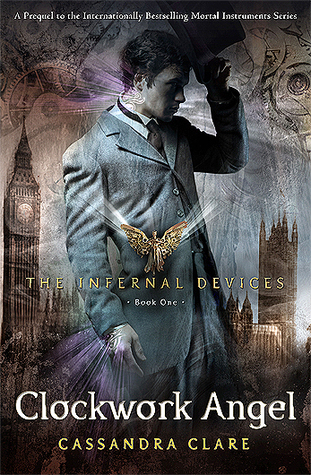 As promised, here is my book review for Clockwork Angel in the Infernal Devices series by Cassandra Clare. (Sorry this took me so long. Better late than never. I'm currently reading the second novel of the series Clockwork Prince and will try to get the review of it finished in a more timely fashion.)
First of all, I'd like to say I really like the setting. I've always had a soft spot for steampunk, especially set in London. I'm also very impressed with the author's knowledge of Victorian literature and culture. Specifically, the author has a verse from a Victorian story or poem at the beginning of every chapter and it's clear that she knows the geography of London as though she lives there.
Another interesting thing about this series is the fact that it's an urban fantasy story. There are elements of gothic horror and mystery. I really like the combination of steampunk and gothic horror which is something I would like to explore in the future as well. As with most young adult literature, there is a love story brewing throughout the book. I won't give any spoilers, but I will say that the love story itself is a strange one and it keeps you guessing..
The theme in this story is a secret organization of "shadowhunters" with angelic bloodlines hunting demons and keeping "mundanes" safe from the things that go bump in the night. While this theme has been done before, I think the author did a good job making the organization feel real with it's inner politics and the strange almost family-like dynamic created by the individuals within the institute.
The main character "Tessa" is a girl that has the power to use an object to transform into the owner of the object and view their memories. While she is a powerful female lead, there's a certain vulnerability to her that I find endearing. Her power makes her useful, but she is rescued by the other members of the institute frequently. While some might frown upon that sort of thing, I think it makes her transformation into a stronger character more important and being set in Victorian London (even though the character is from America) it makes more sense.
The only real criticism I have for this book is I really don't like changing perspectives. This might be a personal pet peeve of mine, but I've read other books that change perspective such as Stephen King's IT and it didn't bother me. Let me explain why I found it particularly irritating in this book.
I'm pretty sure Tessa is supposed to be the main character, but the book shifts between almost every member of the institute's point of view at least once. This means, that you look through another character's eyes at least seven times throughout the book and Tessa isn't in every scene. There are times that I wonder if Tessa is the main character or if Will and Jem are supposed to be the focus.I think Tessa is supposed to be the character the reader associates the most with, but with all the wavering back and forth it's hard to tell.
Also this shift usually happens during a cliffhanger scene when Tessa was in danger. When the character I care most about is in danger, I don't really care about Charlotte discussing institute politics with one of her contacts, I want to know what happened. It has a way of derailing the action and, about the time I get into the scene with the political discussion, I'm suddenly back to where I left off from the chapter before, or in a different scene entirely. It made the story feel disjointed and it kind of gave me spoilers about what the other characters were thinking.
Despite that one issue, this was a very good book. There is enough intrigue and mystery to keep you guessing at what the antagonist wants, though even at the end you don't really know. The ending seems to tie a few things up, but leaves other elements unsolved to explore in the second book. While that is an issue with some people, I don't think of that as a problem. I'm actually about halfway through Clockwork Prince right now, so clearly it left enough of a hook for me to want to buy the series. I suggest you do too. (Though there is only a hint of a love triangle in the first book, that is played up much more in the second.)
Well, I'm off to read more Clockwork Prince. I hope you find this review helpful, and if you like steampunk, gothic horror, hunters, secret organizations, or romance, Clockwork Angel is probably for you.
Tuesday, August 2, 2016
Shadows of the Dark Crystal Review
Hey Everyone,
I just wanted to post a review of "Shadows of the Dark Crystal" by J.M. Lee. I've just finished reading it, and I must say that I'm very impressed. I figured that I would like it, but it was everything I hoped it would be and then some. I'm going to attempt to write this review without spoilers because I highly recommend that you read this book yourself. You will enjoy it, especially if you enjoyed the movie.
The characters are very likable and have excellent motivations for what they do. Their arguments and bantering flows very naturally. At the end of the book there are even some surprises about the motivations of certain characters that I didn't expect. It was great to see the differences between the various clans of Gelfling. I'm hoping that in future books we'll be introduced to the remaining clans as well. The differences between the cultures fueled many interesting conversations with the characters, and it was wonderful the way they banded together to face something greater than their differences.
I was pleasantly surprised with the dark tone of the book. One of the things that most of us remember about the Dark Crystal was that the movie terrified us as children. I'm pleased that these books can frighten a new generation in the same way. The Skeksis are far scarier than the ones in the movie. This might be because they're younger and stronger, but there is another element that makes them particularly terrifying in that they are the ones capturing the Gelfling themselves. They actually kill some of the main characters by the end of the book. (No, I'm not telling you which ones...) Also, the character of "The Hunter" essentially the bogeyman of all Gelfling, and was written in such a way he lived up to the part.
The descriptions of the various settings are very good, as with the descriptions of the characters. Even without the beautiful pictures (and the pictures are gorgeous), you get a very good idea of what everything looks like and there are very few confusing descriptions, especially for a book based in a fantasy universe. While there is a glossary in the back, it's hardly necessary since most of the analogies the characters make are clear enough to get a good idea of what they're referring too, and the "real world" references are at a minimum which shows Lee's experience as a fantasy writer.
I highly recommend this book. It took me only two days to read it because I couldn't put it down. From those of you who read this blog, you know I have two children, so finding time to read this within two days means it had to be exceptionally good. ;-) Well done, Joey. I'm looking very forward to the next one. I knew they picked the right person to write it.
Go buy this book right now!
https://www.amazon.com/Shadows-Dark-Crystal-Jim-Hensons/dp/0448482894/ref=sr_1_1?ie=UTF8&qid=1470153352&sr=8-1&keywords=Shadow+of+the+Dark+Crystal
I just wanted to post a review of "Shadows of the Dark Crystal" by J.M. Lee. I've just finished reading it, and I must say that I'm very impressed. I figured that I would like it, but it was everything I hoped it would be and then some. I'm going to attempt to write this review without spoilers because I highly recommend that you read this book yourself. You will enjoy it, especially if you enjoyed the movie.
The characters are very likable and have excellent motivations for what they do. Their arguments and bantering flows very naturally. At the end of the book there are even some surprises about the motivations of certain characters that I didn't expect. It was great to see the differences between the various clans of Gelfling. I'm hoping that in future books we'll be introduced to the remaining clans as well. The differences between the cultures fueled many interesting conversations with the characters, and it was wonderful the way they banded together to face something greater than their differences.
I was pleasantly surprised with the dark tone of the book. One of the things that most of us remember about the Dark Crystal was that the movie terrified us as children. I'm pleased that these books can frighten a new generation in the same way. The Skeksis are far scarier than the ones in the movie. This might be because they're younger and stronger, but there is another element that makes them particularly terrifying in that they are the ones capturing the Gelfling themselves. They actually kill some of the main characters by the end of the book. (No, I'm not telling you which ones...) Also, the character of "The Hunter" essentially the bogeyman of all Gelfling, and was written in such a way he lived up to the part.
The descriptions of the various settings are very good, as with the descriptions of the characters. Even without the beautiful pictures (and the pictures are gorgeous), you get a very good idea of what everything looks like and there are very few confusing descriptions, especially for a book based in a fantasy universe. While there is a glossary in the back, it's hardly necessary since most of the analogies the characters make are clear enough to get a good idea of what they're referring too, and the "real world" references are at a minimum which shows Lee's experience as a fantasy writer.
I highly recommend this book. It took me only two days to read it because I couldn't put it down. From those of you who read this blog, you know I have two children, so finding time to read this within two days means it had to be exceptionally good. ;-) Well done, Joey. I'm looking very forward to the next one. I knew they picked the right person to write it.
Go buy this book right now!
https://www.amazon.com/Shadows-Dark-Crystal-Jim-Hensons/dp/0448482894/ref=sr_1_1?ie=UTF8&qid=1470153352&sr=8-1&keywords=Shadow+of+the+Dark+Crystal
Friday, June 27, 2014
Dark Crystal Author Quest
Hey Everyone,
The Dark Crystal Author Quest e-book is finally available through amazon. :-)
If you're a fan of The Dark Crystal, Jim Henson, or Penguin Books, please pick up a copy. There are five very good stories within it that are worth your time and money. This might sound like a shameless plug for my own work, but it isn't because all of the stories were very fun to read and fit very well in the Dark Crystal universe. If you like the Dark Crystal, you'll like this e-book.
I picked up the book the first day it was available, June 24th, and I'm very honored to be included with so many good authors. I must admit, though, I'm not as confident about potentially winning the contest after reading the other stories. I think I have as good a chance as anyone, but I think the Jim Henson company has their work judging cut out for them. I'm still praying to win it. Every one of the featured authors, myself included, has something different to offer in their interpretation of the universe, and all of us have different strengths and weaknesses as writers. I think what it really comes down to is what type of story the Jim Henson company wants, and it isn't a bad reflection on any of us as writers if we lose.
When I first became one of the five finalists, that I was looking at the other four finalists as competition, and I didn't like myself for it. I try not to be the type of person to be jealous or bitter. I can be a sore loser on small things, like video games, but on bigger things I don't tend to be that way. For some reason, this time I started to feel really competitive, and I didn't like the feeling.
Long story short, I decided that wasn't who I was, and I started looking at the other finalists as people, and colleagues. We're all in this book together, and we all want the same thing, so why not make this a friendly competition? We all have at least one thing in common, other than this book as well--we're all writers. I've already reached out to one of the finalists and I think we've become pretty good pen pal type friends. I'll probably reach out to the others as well at some point in the very near future. If they don't want to be "friend friends" that's fine, but I feel like wishing everyone "good luck." I still want to win, but I am hoping that whoever is chosen is the best person for the job. Depending on what Jim Henson's would want, I may or may not be that person. I think that I can be.
Anyway, I rambled on about this for too long. Time to review the book. (To those who have seen the movie "The Dark Crystal" there are no spoilers in this review...if you haven't perhaps you should wait and watch the movie or read the book first.)
Vinni Chiappini "The Gelfling Guardian" - This story features a Gelfling of the Spriton Clan who works as a guard of the Castle of the Crystal. He looks to the Skeksis with respect and admiration until he finds out that they might be responsible for the disappearances of Gelfling and Podlings all over Thra. He has to decide between his loyalty to them, or his loyalty to his people and search for the truth. I think the strongest element of this story is that the Podlings were portrayed as a very sympathetic, intelligent race, which is important since they are the first victims of the crystal. It makes the sacrifice of the Podlings a very real problem.
Greg Coles "Rebels of the Dark Crystal" - The main character of this story is a Harath (Woodland) Clan Gelfling who is crippled and working as a blacksmith in the woods. His friend, a soldier of the Crystal Castle, stumbles into his forge one evening in shambles, and accidentally dreamfasts with him. Through the dreamfasting, he learns that the soldier discovered a terrible secret kept by the Skeksis that puts him in terrible danger as well. One of the strengths of Coles' story is that it's written in first person, so it pulls the reader in and makes the main character very sympathetic. Also, since the main character is disabled, it makes his struggle particularly poignant.
Nancy Gray "Chosen" - Sorry, I'm not reviewing my own story, that would be silly. Please, read it and tell me what you think. It's about a Gelfling of the Sifa Clan that is chased by a waterspout onto a deserted island. While there, he and his friend find an abandoned cabin containing a journal with information about the Skeksis that puts them and their families in danger.
J. M. Lee "Shadows of the Dark Crystal" - This story is about a Gelfling girl from the Drenchen Clan who goes to find her cousin, a guard at the Castle of Crystal, and finds more than she expected. She and her Father are attacked by a huge nebrie that has been driven mad by the crystal's darkened light. She must travel alone to find Aughra to tell her what happened and for advice. Lee's descriptions of setting are eloquent and beautiful, painting the images into the mind's eye. His characters are also likable and the creatures are interesting, especially the Gelfling girl's pet.
Esther Palmer "Music of the Shards" - A young Gelfling girl from the Vapra Clan is playing just outside of her village when the child she's playing with is killed by a Skeksis, "The Hunter." She finds out that her Grandmother is the keeper of a journal from a soldier from the Castle of Crystal. She tells Esther to go to Aughra with the journal to find out what to do, but it seems her journey is far from over. Palmer has a way with words and some very vivid imagery, especially in darker scenes.
That's about it for the review. As I've said, I don't envy the judges for having to choose between so many good stories. I hope that I win, but right now I just feel honored to be among this very talented group of finalists. Please, consider buying this book. You won't regret it.
Keep reading and writing, and never give up.
The Dark Crystal Author Quest e-book is finally available through amazon. :-)
If you're a fan of The Dark Crystal, Jim Henson, or Penguin Books, please pick up a copy. There are five very good stories within it that are worth your time and money. This might sound like a shameless plug for my own work, but it isn't because all of the stories were very fun to read and fit very well in the Dark Crystal universe. If you like the Dark Crystal, you'll like this e-book.
I picked up the book the first day it was available, June 24th, and I'm very honored to be included with so many good authors. I must admit, though, I'm not as confident about potentially winning the contest after reading the other stories. I think I have as good a chance as anyone, but I think the Jim Henson company has their work judging cut out for them. I'm still praying to win it. Every one of the featured authors, myself included, has something different to offer in their interpretation of the universe, and all of us have different strengths and weaknesses as writers. I think what it really comes down to is what type of story the Jim Henson company wants, and it isn't a bad reflection on any of us as writers if we lose.
When I first became one of the five finalists, that I was looking at the other four finalists as competition, and I didn't like myself for it. I try not to be the type of person to be jealous or bitter. I can be a sore loser on small things, like video games, but on bigger things I don't tend to be that way. For some reason, this time I started to feel really competitive, and I didn't like the feeling.
Long story short, I decided that wasn't who I was, and I started looking at the other finalists as people, and colleagues. We're all in this book together, and we all want the same thing, so why not make this a friendly competition? We all have at least one thing in common, other than this book as well--we're all writers. I've already reached out to one of the finalists and I think we've become pretty good pen pal type friends. I'll probably reach out to the others as well at some point in the very near future. If they don't want to be "friend friends" that's fine, but I feel like wishing everyone "good luck." I still want to win, but I am hoping that whoever is chosen is the best person for the job. Depending on what Jim Henson's would want, I may or may not be that person. I think that I can be.
Anyway, I rambled on about this for too long. Time to review the book. (To those who have seen the movie "The Dark Crystal" there are no spoilers in this review...if you haven't perhaps you should wait and watch the movie or read the book first.)
Vinni Chiappini "The Gelfling Guardian" - This story features a Gelfling of the Spriton Clan who works as a guard of the Castle of the Crystal. He looks to the Skeksis with respect and admiration until he finds out that they might be responsible for the disappearances of Gelfling and Podlings all over Thra. He has to decide between his loyalty to them, or his loyalty to his people and search for the truth. I think the strongest element of this story is that the Podlings were portrayed as a very sympathetic, intelligent race, which is important since they are the first victims of the crystal. It makes the sacrifice of the Podlings a very real problem.
Greg Coles "Rebels of the Dark Crystal" - The main character of this story is a Harath (Woodland) Clan Gelfling who is crippled and working as a blacksmith in the woods. His friend, a soldier of the Crystal Castle, stumbles into his forge one evening in shambles, and accidentally dreamfasts with him. Through the dreamfasting, he learns that the soldier discovered a terrible secret kept by the Skeksis that puts him in terrible danger as well. One of the strengths of Coles' story is that it's written in first person, so it pulls the reader in and makes the main character very sympathetic. Also, since the main character is disabled, it makes his struggle particularly poignant.
Nancy Gray "Chosen" - Sorry, I'm not reviewing my own story, that would be silly. Please, read it and tell me what you think. It's about a Gelfling of the Sifa Clan that is chased by a waterspout onto a deserted island. While there, he and his friend find an abandoned cabin containing a journal with information about the Skeksis that puts them and their families in danger.
J. M. Lee "Shadows of the Dark Crystal" - This story is about a Gelfling girl from the Drenchen Clan who goes to find her cousin, a guard at the Castle of Crystal, and finds more than she expected. She and her Father are attacked by a huge nebrie that has been driven mad by the crystal's darkened light. She must travel alone to find Aughra to tell her what happened and for advice. Lee's descriptions of setting are eloquent and beautiful, painting the images into the mind's eye. His characters are also likable and the creatures are interesting, especially the Gelfling girl's pet.
Esther Palmer "Music of the Shards" - A young Gelfling girl from the Vapra Clan is playing just outside of her village when the child she's playing with is killed by a Skeksis, "The Hunter." She finds out that her Grandmother is the keeper of a journal from a soldier from the Castle of Crystal. She tells Esther to go to Aughra with the journal to find out what to do, but it seems her journey is far from over. Palmer has a way with words and some very vivid imagery, especially in darker scenes.
That's about it for the review. As I've said, I don't envy the judges for having to choose between so many good stories. I hope that I win, but right now I just feel honored to be among this very talented group of finalists. Please, consider buying this book. You won't regret it.
Keep reading and writing, and never give up.
Wednesday, June 4, 2014
Skin Game and Childhood Horror
I borrowed the new Dresden Files book, "Skin Game," and once again I can't say enough good things about that series. I'll be adding it to the collection once I have the money, but I need to buy some of the other previous books first. One thing at a time, maybe one day I'll have an income...
Anyway, continuing with the book review, the characters are all so good that I can't really pick a favorite (though, I'm favoring Waldo Butters right now), and the plot had me so hooked that I finished reading it in three days. I missed out on a little sleep, but it was worth it. Jim Butcher really knows how to create likable, awesome characters and some very disturbing villains. One of the things I think is most important about writing a good book is coming up with good characters, but he also has interesting plot twists, humor, drama, and a great setting. I usually write specifics about the books I review, but this time I'm not going to go into a thorough review since it would give away plot from the previous books. I will say if you haven't read this series, seriously, go pick up "Storm Front" right now. This is the best urban fantasy series I've ever read and the books just keep getting better.
I've also been reading some young reader horror to get an idea about how to write my story. I've been pleasantly surprised. I read "Scary Stories, Goodnight Zombie" by James Preller, and am currently reading "Wanted, The Haunted Mask" by R. L. Stine. I didn't think that they would be very graphic or scary, but I was wrong. I remember being scared by R. L. Stine books when I was a young reader and enjoying them, but I didn't expect to be so impressed by them now that I'm an adult.
Even though I'm going to tone down my violence a bit for my story, it seems I don't need to tone down very much. The descriptions of the flesh dangling over the main characters eye feeling like hamburger meat, in "Goodnight Zombie," surprised me. And, even more disturbing, the old man at the beginning of "Wanted, the Haunted Mask" pulls the mask off of his face and the flesh from his face with it, killing him. Long story short, it makes me think my descriptions in my horror story might even be pretty tame in comparison.
I shouldn't be too surprised. Children are fascinated by gore and tend to enjoy a safe scare. The world is a pretty scary place, and I believe (much like Jim Henson) that sometimes being a little scared from a story is healthy for a child, especially if the story shows the character being brave and standing up to things that frighten him/her. I remember when I was in elementary school reading "Scary Stories to Tell in the Dark" with my best friend and being horrified and fascinated at the same time. I think, I can write my story to be scary, and that children that like scary stories will be able to handle it.
If I end up winning the Dark Crystal contest, I'll put this project on hold for a later date, but in the meantime, it's very fun to read these type of books again and work on something new.
In conclusion, READ "SKIN GAME" BY JIM BUTCHER! It's the best one in the Dresden Files yet, but be sure to read this series in order. One thing that is slightly negative about the Dresden Files is there are a LOT of characters and villains, and if you don't read the books in order, you will be lost.
Also, if you want to remember what it was like to be freaked out by scary stories as a kid, read James Preller or R. L. Stine. (And,one day maybe even, "Nancy Gray," who also hopefully wrote the first prequel series for "The Dark Crystal." Hey, I'm allowed to dream! No I haven't heard anything back yet and only have a one in five chance of winning, but if I've learned anything from this process it's to be optimistic.) ;-) Anyway, Take care everybody. Keep reading!
Anyway, continuing with the book review, the characters are all so good that I can't really pick a favorite (though, I'm favoring Waldo Butters right now), and the plot had me so hooked that I finished reading it in three days. I missed out on a little sleep, but it was worth it. Jim Butcher really knows how to create likable, awesome characters and some very disturbing villains. One of the things I think is most important about writing a good book is coming up with good characters, but he also has interesting plot twists, humor, drama, and a great setting. I usually write specifics about the books I review, but this time I'm not going to go into a thorough review since it would give away plot from the previous books. I will say if you haven't read this series, seriously, go pick up "Storm Front" right now. This is the best urban fantasy series I've ever read and the books just keep getting better.
I've also been reading some young reader horror to get an idea about how to write my story. I've been pleasantly surprised. I read "Scary Stories, Goodnight Zombie" by James Preller, and am currently reading "Wanted, The Haunted Mask" by R. L. Stine. I didn't think that they would be very graphic or scary, but I was wrong. I remember being scared by R. L. Stine books when I was a young reader and enjoying them, but I didn't expect to be so impressed by them now that I'm an adult.
Even though I'm going to tone down my violence a bit for my story, it seems I don't need to tone down very much. The descriptions of the flesh dangling over the main characters eye feeling like hamburger meat, in "Goodnight Zombie," surprised me. And, even more disturbing, the old man at the beginning of "Wanted, the Haunted Mask" pulls the mask off of his face and the flesh from his face with it, killing him. Long story short, it makes me think my descriptions in my horror story might even be pretty tame in comparison.
I shouldn't be too surprised. Children are fascinated by gore and tend to enjoy a safe scare. The world is a pretty scary place, and I believe (much like Jim Henson) that sometimes being a little scared from a story is healthy for a child, especially if the story shows the character being brave and standing up to things that frighten him/her. I remember when I was in elementary school reading "Scary Stories to Tell in the Dark" with my best friend and being horrified and fascinated at the same time. I think, I can write my story to be scary, and that children that like scary stories will be able to handle it.
If I end up winning the Dark Crystal contest, I'll put this project on hold for a later date, but in the meantime, it's very fun to read these type of books again and work on something new.
In conclusion, READ "SKIN GAME" BY JIM BUTCHER! It's the best one in the Dresden Files yet, but be sure to read this series in order. One thing that is slightly negative about the Dresden Files is there are a LOT of characters and villains, and if you don't read the books in order, you will be lost.
Also, if you want to remember what it was like to be freaked out by scary stories as a kid, read James Preller or R. L. Stine. (And,one day maybe even, "Nancy Gray," who also hopefully wrote the first prequel series for "The Dark Crystal." Hey, I'm allowed to dream! No I haven't heard anything back yet and only have a one in five chance of winning, but if I've learned anything from this process it's to be optimistic.) ;-) Anyway, Take care everybody. Keep reading!
Thursday, October 4, 2012
50 Shades of...Oh My!
Well, I promised that I would write this review about the 50 Shades of Grey trilogy before I thought better of it, so here it goes. I'm going to try to explain what is good and bad about these books, and I'm going to try to, above all, be fair. Initially, I was going to make this more amusing and poke a bit of fun at it, but I've noticed from others who have read these books that the reviews tend to totally trash them. There are actually good things about these books and I think being that harsh with a new writer is rude. So, here is what I hope is a fair assessment. Let's get the bad over with first...
First of all, I'm not sure what all of the fuss is about. These kinds of stories have been around for a very long time. Just look up BDSM short stories on the internet and see what comes up. I assure you it'll be ten times worse than the 50 Shades of Grey series. I think the "big deal" is that this one was marketed towards a normal book store as opposed to where you would normally find a book like this. Also, many people never were exposed to this lifestyle before reading these books. However, despite the fact that the books are mildly pornographic, the scenes are no worse than those of any other trashy romance novel. There's a lot of sex in the trilogy, to the point it eventually gets to be repetitive, almost boring, but clearly there is a market for that sort of thing.
The biggest problem I saw with this series are problems that stem from the fact E. L. James is a new writer. She repeats words and phrases throughout the entire book series. Word variation is one of those things that's important because a reader literally gets bored when you use the same words over and over again, and it makes it seem that you don't have an extensive vocabulary. I think E. L. James can do better due to the use of words like "mercurial." (Though, I have to admit, "mercurial" got on my nerves. I had never heard that word before I got these books and by the end of them it was ingrained in my head.) Also, let's just say George Takei ruined the phrase "oh my" for me. Every time there was an "oh my" in a love scene, I heard it in the George Takei voice and saw him saying it. Kind of a mood killer...
There was another problem with the third book that the other two didn't have that I feel needs to be mentioned. At the beginning there are a series of flashbacks. The flashbacks occur every other chapter until about page eighty. Never put that many flashbacks in a book, especially in the beginning of one. It was hard to get into "Fifty Shades Freed" because I was interested in what was happening in the "now" and when we backtracked it derailed my interest. Too many disjointed flashbacks is a common problem for new writers as well. I've done that before, but not every other chapter like that. Truthfully, there is a long flashback in the opening of my new book, but it isn't disjointed. It's jarring to go from flashback to present, flashback to present, flashback to present.
Finally, I do take issue that this was a Twilight fanfic. I somehow managed to look at it from an unbiased perspective, but occasionally, I just couldn't. I felt more needed to be changed for me to appreciate it as a work that stood alone.
Still, there are several good things she did to make it stand apart. The back story for Christian Grey was good (it actually reminded me a good deal of the back story for "Dexter," making me wonder if she was inspired by that as well). The characters weren't as annoying as those in Twilight either. I could actually identify with the main character, even though she was VERY naive for her age, something I had trouble doing with Bella, Edward, or Jacob when I read that series. (I'm not even going to bother to review that one. The story falls apart when you realize that Edward is over a hundred years old and falls in love with a teenager. I'm thirty and I hate angsty teenagers now. Also, he's practically starving on the animal blood, and she smells like a steak--he would've eaten her.) Anyway, Christian Grey was a very interesting character that had emotional depth. Even though we're seeing things through Anastasia's eyes, Christian is the main character of the series, which I thought was a kind of interesting twist.
Also, for being a "dominant" Grey actually is a pretty likeable character. If you've ever read anything else like this, most of the time the men are complete and utter scoundrels with no redeeming qualities. If you are just learning about this sort of thing from these books DON'T read Anne Rice's "Sleeping Beauty." I've read stories like this before, and I couldn't get sixty pages into that book because the man was such a jerk I wanted to kill him. Grey is different. He actually does have redeeming qualities, but you do need to keep an open mind and give the series a chance for them to come into play. Also, this is a story about redemption and overcoming the things from his past that make him the way that he is. By the end of the series, he's changed a good deal and so has Ana.
The stories themselves were actually pretty addictive. There was enough action going on in the background that I found myself skimming some of the sex scenes because I wanted to see what happened next. Even though it was "convenient" for one of the villains from Christian's past to come up randomly by crossing Anastasia's path, I think that's a plot device that all of us are guilty of using every now and again. And, I know from experience, the world is a lot smaller than I'd like it to be, so that's one of the complaints about these books I don't agree with and found actually plausible.
Long story short, I actually liked these books. The action (I mean the story not the ahem...action) kept my attention and I read all three. The writing style needs work, but I think E.L. James could be a much better writer with more practice. By the third book many of my complaints except for the additional one were already getting better. She's extremely lucky to have her books catch on like wildfire, but I think she knows that, and I'm happy for her. I'm legitimately happy for her. It was a pleasant surprise at the end of the series that she had a large, all caps "Thank you so much for reading," blurb. She appreciates her fans, and that's a good quality in a writer.
J.K. Rowling said, when she found out how well this book sold, "maybe I should've had Harry be more creative with his wand." What a smarmy thing to say about someone else's work when Rowling was just as lucky to have her work catch on like it did. The witch and wizard school concept has been done before. The first time I was exposed to it was from the Disney movie "Worst Witch." I swear, the more I hear about that woman the less I like her...don't get me started on the "resource book" case. She's a good writer, but I'm becoming convinced that fame has gone to her head and being a good writer isn't everything.
My point is, I think we're all being a little harsh and I think it stems more out of jealousy than legitimate complaint. We try and try to do everything right so that our books will get published. We strive to make our books less cliche, make sure our grammar is impeccable, not repeat our words, and someone came along who broke those rules and is now a millionaire with the biggest audience base a book has gotten in a very long time. It actually gives me hope. I think that means that if there's a market for a certain type of story, your audience will forgive you for your stylistic shortcomings. Thank goodness for that, because I know I have a long way to go.
And that's my review. This has been pretty long...oh my!
First of all, I'm not sure what all of the fuss is about. These kinds of stories have been around for a very long time. Just look up BDSM short stories on the internet and see what comes up. I assure you it'll be ten times worse than the 50 Shades of Grey series. I think the "big deal" is that this one was marketed towards a normal book store as opposed to where you would normally find a book like this. Also, many people never were exposed to this lifestyle before reading these books. However, despite the fact that the books are mildly pornographic, the scenes are no worse than those of any other trashy romance novel. There's a lot of sex in the trilogy, to the point it eventually gets to be repetitive, almost boring, but clearly there is a market for that sort of thing.
The biggest problem I saw with this series are problems that stem from the fact E. L. James is a new writer. She repeats words and phrases throughout the entire book series. Word variation is one of those things that's important because a reader literally gets bored when you use the same words over and over again, and it makes it seem that you don't have an extensive vocabulary. I think E. L. James can do better due to the use of words like "mercurial." (Though, I have to admit, "mercurial" got on my nerves. I had never heard that word before I got these books and by the end of them it was ingrained in my head.) Also, let's just say George Takei ruined the phrase "oh my" for me. Every time there was an "oh my" in a love scene, I heard it in the George Takei voice and saw him saying it. Kind of a mood killer...
There was another problem with the third book that the other two didn't have that I feel needs to be mentioned. At the beginning there are a series of flashbacks. The flashbacks occur every other chapter until about page eighty. Never put that many flashbacks in a book, especially in the beginning of one. It was hard to get into "Fifty Shades Freed" because I was interested in what was happening in the "now" and when we backtracked it derailed my interest. Too many disjointed flashbacks is a common problem for new writers as well. I've done that before, but not every other chapter like that. Truthfully, there is a long flashback in the opening of my new book, but it isn't disjointed. It's jarring to go from flashback to present, flashback to present, flashback to present.
Finally, I do take issue that this was a Twilight fanfic. I somehow managed to look at it from an unbiased perspective, but occasionally, I just couldn't. I felt more needed to be changed for me to appreciate it as a work that stood alone.
Still, there are several good things she did to make it stand apart. The back story for Christian Grey was good (it actually reminded me a good deal of the back story for "Dexter," making me wonder if she was inspired by that as well). The characters weren't as annoying as those in Twilight either. I could actually identify with the main character, even though she was VERY naive for her age, something I had trouble doing with Bella, Edward, or Jacob when I read that series. (I'm not even going to bother to review that one. The story falls apart when you realize that Edward is over a hundred years old and falls in love with a teenager. I'm thirty and I hate angsty teenagers now. Also, he's practically starving on the animal blood, and she smells like a steak--he would've eaten her.) Anyway, Christian Grey was a very interesting character that had emotional depth. Even though we're seeing things through Anastasia's eyes, Christian is the main character of the series, which I thought was a kind of interesting twist.
Also, for being a "dominant" Grey actually is a pretty likeable character. If you've ever read anything else like this, most of the time the men are complete and utter scoundrels with no redeeming qualities. If you are just learning about this sort of thing from these books DON'T read Anne Rice's "Sleeping Beauty." I've read stories like this before, and I couldn't get sixty pages into that book because the man was such a jerk I wanted to kill him. Grey is different. He actually does have redeeming qualities, but you do need to keep an open mind and give the series a chance for them to come into play. Also, this is a story about redemption and overcoming the things from his past that make him the way that he is. By the end of the series, he's changed a good deal and so has Ana.
The stories themselves were actually pretty addictive. There was enough action going on in the background that I found myself skimming some of the sex scenes because I wanted to see what happened next. Even though it was "convenient" for one of the villains from Christian's past to come up randomly by crossing Anastasia's path, I think that's a plot device that all of us are guilty of using every now and again. And, I know from experience, the world is a lot smaller than I'd like it to be, so that's one of the complaints about these books I don't agree with and found actually plausible.
Long story short, I actually liked these books. The action (I mean the story not the ahem...action) kept my attention and I read all three. The writing style needs work, but I think E.L. James could be a much better writer with more practice. By the third book many of my complaints except for the additional one were already getting better. She's extremely lucky to have her books catch on like wildfire, but I think she knows that, and I'm happy for her. I'm legitimately happy for her. It was a pleasant surprise at the end of the series that she had a large, all caps "Thank you so much for reading," blurb. She appreciates her fans, and that's a good quality in a writer.
J.K. Rowling said, when she found out how well this book sold, "maybe I should've had Harry be more creative with his wand." What a smarmy thing to say about someone else's work when Rowling was just as lucky to have her work catch on like it did. The witch and wizard school concept has been done before. The first time I was exposed to it was from the Disney movie "Worst Witch." I swear, the more I hear about that woman the less I like her...don't get me started on the "resource book" case. She's a good writer, but I'm becoming convinced that fame has gone to her head and being a good writer isn't everything.
My point is, I think we're all being a little harsh and I think it stems more out of jealousy than legitimate complaint. We try and try to do everything right so that our books will get published. We strive to make our books less cliche, make sure our grammar is impeccable, not repeat our words, and someone came along who broke those rules and is now a millionaire with the biggest audience base a book has gotten in a very long time. It actually gives me hope. I think that means that if there's a market for a certain type of story, your audience will forgive you for your stylistic shortcomings. Thank goodness for that, because I know I have a long way to go.
And that's my review. This has been pretty long...oh my!
Friday, July 20, 2012
Mistborn
As promised, I'm reviewing Mistborn today. This book is still pretty fresh in my mind. For those of you who have never read my reviews, I try not to put spoilers in, so no worries. I start with about the same sort of synopsis you would find on the back of the book (with a little more pertinent information) and go from there. I will have to detail the magic system in this review though, since it's one of the things that sets this series apart.
This book is about a young girl named Vin who started life as a criminal on the streets of the city of Luthadel. Vin never got a chance to improve her situation because she was one of the skaa, a race of people that once defied the "Lord Ruler." The Lord Ruler is the ruler of the realm who is worshiped as a god. Meanwhile, a thief named Kelsier is on his own mission to overthrow the Lord Ruler and to incite rebellion from the skaa that have been oppressed for so long.
When their paths cross, Vin becomes involved with the rebellion and learns that she, like Kelsier, is a "Mistborn." By swallowing metals she harnesses the power within them. This is called "allomancy." There are ten basic metals they can use, but they must be of a pure alloy. Iron pulls on metals, Steel pushes on them, Tin enhances senses, Pewter enhances physical abilities, Brass soothes emotions, Zinc riots emotions, Copper hides allomancy, Bronze reveals allomancy, and Gold lets a person see what would have happened in the past if things had remained unchanged, while Atium (a rare, valuable metal) allows one to see a few seconds into the future. There supposedly is also an eleventh metal with mysterious properties. Still, Vin has to keep her abilities secret. Nobles can be Mistborn and are considered valuable if they are, but skaa are hunted down and killed for that ability. It means they have noble blood in their heritage, which is against the law.
Vin impersonates a noble to incite a riot among the noble houses, and becomes caught between the worlds of the skaa and the nobility. She learns the dark secrets of the nobility, and secrets hidden about Lord Ruler himself, and eventually overcomes her distrust and learns what it's like to feel loyalty and love.
Character development was excellent. This is one of the best examples of good character development that I've seen. Each of the main characters undergoes a very drastic change throughout the course of the book. Vin is entirely different by the end of the book than she was at the beginning, and the change is definitely for the better. Each of the main characters are likeable in their own way and you do become attached to them.
There is an interesting use of religious symbolism in the book, which actually is mostly non-offensive. It's not preachy about the points being made, but the symbolism is there. I won't give away much about the plot, but you'll know what I'm talking about when you get to it. Still, it wasn't a predictable element and I also liked the way it was executed.
The setting was interesting and felt very fleshed out. (The book also included map at the beginning, which I liked.) The creatures relevant to the plot, such as the mist wraiths, were very original and well described. I really liked the concept behind mist wraiths because the creatures were scary but somehow seemed natural. The setting is captivating because it feels as though each city and place has a history. The different factions of the government, the nobles, obligaters, and inquisitors, are all very distinct and hold intriguing secrets. City districts are described and very distinct from one another, as are the keeps of the nobles. The description of the Lord Ruler's castle is very intriguing as well. One thing that you'll notice as you read is that Sanderson is very descriptive and you can literally picture the places and things he describes perfectly.
The magic system was original and very interesting. I mentioned the way it works in the plot synopsis above, but it's a little more complex than that. Most characters can only burn one of the various types of metals, only the most powerfully gifted can burn more than one. The metals are related to one another (which you probably noticed from the description). Some work externally by affecting the world around them, while some work internally by improving one's own abilities. The characters can practically fly when they burn Steel and Iron, pushing and pulling themselves along windowsills, fire escapes, etc. Also, when they burn Pewter, they can push their bodies well past their limits and run at super human speeds. Still, tricking the opponent and using the abilities in creative ways is often what saves Vin throughout the book. It's great that the magic system is simplistic enough to follow but there are other tricks to using it that allow a the characters to hold their own against obviously more powerful foes.
The only real drawback to this book is it was a very long novel at over six hundred pages. Be sure to read it when you have the time because you won't want to put it down. (It's killing me too, because I want to read the other two books of the series, but I don't have the money to buy them currently and I also don't have time to read them before the convention. I was hoping to read them all in case I get to meet Brandon Sanderson, but I can still gush over this one.) Anyway, this was an excellent read. Pick it up if you like fantasy, intriguing political rebellions, or good, realistic characters.
This book is about a young girl named Vin who started life as a criminal on the streets of the city of Luthadel. Vin never got a chance to improve her situation because she was one of the skaa, a race of people that once defied the "Lord Ruler." The Lord Ruler is the ruler of the realm who is worshiped as a god. Meanwhile, a thief named Kelsier is on his own mission to overthrow the Lord Ruler and to incite rebellion from the skaa that have been oppressed for so long.
When their paths cross, Vin becomes involved with the rebellion and learns that she, like Kelsier, is a "Mistborn." By swallowing metals she harnesses the power within them. This is called "allomancy." There are ten basic metals they can use, but they must be of a pure alloy. Iron pulls on metals, Steel pushes on them, Tin enhances senses, Pewter enhances physical abilities, Brass soothes emotions, Zinc riots emotions, Copper hides allomancy, Bronze reveals allomancy, and Gold lets a person see what would have happened in the past if things had remained unchanged, while Atium (a rare, valuable metal) allows one to see a few seconds into the future. There supposedly is also an eleventh metal with mysterious properties. Still, Vin has to keep her abilities secret. Nobles can be Mistborn and are considered valuable if they are, but skaa are hunted down and killed for that ability. It means they have noble blood in their heritage, which is against the law.
Vin impersonates a noble to incite a riot among the noble houses, and becomes caught between the worlds of the skaa and the nobility. She learns the dark secrets of the nobility, and secrets hidden about Lord Ruler himself, and eventually overcomes her distrust and learns what it's like to feel loyalty and love.
Character development was excellent. This is one of the best examples of good character development that I've seen. Each of the main characters undergoes a very drastic change throughout the course of the book. Vin is entirely different by the end of the book than she was at the beginning, and the change is definitely for the better. Each of the main characters are likeable in their own way and you do become attached to them.
There is an interesting use of religious symbolism in the book, which actually is mostly non-offensive. It's not preachy about the points being made, but the symbolism is there. I won't give away much about the plot, but you'll know what I'm talking about when you get to it. Still, it wasn't a predictable element and I also liked the way it was executed.
The setting was interesting and felt very fleshed out. (The book also included map at the beginning, which I liked.) The creatures relevant to the plot, such as the mist wraiths, were very original and well described. I really liked the concept behind mist wraiths because the creatures were scary but somehow seemed natural. The setting is captivating because it feels as though each city and place has a history. The different factions of the government, the nobles, obligaters, and inquisitors, are all very distinct and hold intriguing secrets. City districts are described and very distinct from one another, as are the keeps of the nobles. The description of the Lord Ruler's castle is very intriguing as well. One thing that you'll notice as you read is that Sanderson is very descriptive and you can literally picture the places and things he describes perfectly.
The magic system was original and very interesting. I mentioned the way it works in the plot synopsis above, but it's a little more complex than that. Most characters can only burn one of the various types of metals, only the most powerfully gifted can burn more than one. The metals are related to one another (which you probably noticed from the description). Some work externally by affecting the world around them, while some work internally by improving one's own abilities. The characters can practically fly when they burn Steel and Iron, pushing and pulling themselves along windowsills, fire escapes, etc. Also, when they burn Pewter, they can push their bodies well past their limits and run at super human speeds. Still, tricking the opponent and using the abilities in creative ways is often what saves Vin throughout the book. It's great that the magic system is simplistic enough to follow but there are other tricks to using it that allow a the characters to hold their own against obviously more powerful foes.
The only real drawback to this book is it was a very long novel at over six hundred pages. Be sure to read it when you have the time because you won't want to put it down. (It's killing me too, because I want to read the other two books of the series, but I don't have the money to buy them currently and I also don't have time to read them before the convention. I was hoping to read them all in case I get to meet Brandon Sanderson, but I can still gush over this one.) Anyway, this was an excellent read. Pick it up if you like fantasy, intriguing political rebellions, or good, realistic characters.
Wednesday, June 20, 2012
Almost There
Good news, everyone,
It looks like the website will be finished very soon. It might not be done by the end of the week, but I'm down to just the finishing touches. I think that it's turned out pretty well, and I hope that you all like it. As soon as I finish, I'll add a link to the website on the blog and there will be a link to the blog from the website as well.
Currently, I'm working on "Blood Rain" and I've written nearly 75,000 words. It's very close to the end. I think I have about three or four more chapters to go. I've got the teaser intro to the novel under writing samples in the website. I hope you enjoy it. When I'm done, I'll take a little break and start writing the notes for the second book in the series. My goals are to get the book, the website, and the design of my business cards, done by the time I go to the beach in July. (My family always goes to the beach around July 4th, kind of a little tradition that we have, and I don't want to be stressing out over anything.)
While I'm at the beach, I might do a little work. I was thinking I could work on those notes for the second book, as well as read, read, read. I've already read three and a half books by four different authors over the past two months or so. I'm trying to expose myself to different writers and different writing styles. I love Jim Butcher to death, but I do need a little variety in who I read. For a long time, I was reading the Dresden Files and the Codex Alera, so I didn't have time to vary my authors much.
I finished The Graveyard Book by Neil Gaiman recently. I highly recommend it. It is extremely dark for a children's novel and is a very interesting rewrite of The Jungle Book. Like I said, I've been reading lots of books lately, so I can't do an in depth review of all of them right now, but I probably will in the future. In the meantime, here are some mini-reviews.
I read Laurell K. Hamilton's "Guilty Pleasures" and really enjoyed it. It's an urban fantasy story about Anita Blake, someone who raises the dead and hunts vampires. I enjoyed the personality of the main character immensely, and the book was a very fast read. I was extremely sad when one of my favorite characters died in the book, but I'm not telling you who it was. Spoilers aren't fun for anyone. I'm hoping to read another of the Anita Blake series while I'm at the beach.
As a change of pace, I also read a romance by Sherrilyn Kenyon, the first of the "Dark Hunter" series. I don't read romance very often, so I might not be the best person to ask to review it, but I did enjoy the book. The universe that it is set in is very interesting. The characters remind me of the White Wolf game "Scion." The male love interest was an immortal man working for the Greek goddess Artemis to kill the corrupted sons and daughters of Apollo. The only way to get his soul back from Artemis was to put his trust in the love of a woman, something that had burned him before.
Currently, I'm reading "Mistborn" by Brandon Sanderson. It took me a little time to get into it, but I really like the way magic works in his universe. I'll probably be reading more by him in the future as well. I might write a review when I'm finished.
Well, sorry I talked your ear off again. I need to get back to work on my writing. Wish me luck on meeting my personal deadlines, for once. ;-)
It looks like the website will be finished very soon. It might not be done by the end of the week, but I'm down to just the finishing touches. I think that it's turned out pretty well, and I hope that you all like it. As soon as I finish, I'll add a link to the website on the blog and there will be a link to the blog from the website as well.
Currently, I'm working on "Blood Rain" and I've written nearly 75,000 words. It's very close to the end. I think I have about three or four more chapters to go. I've got the teaser intro to the novel under writing samples in the website. I hope you enjoy it. When I'm done, I'll take a little break and start writing the notes for the second book in the series. My goals are to get the book, the website, and the design of my business cards, done by the time I go to the beach in July. (My family always goes to the beach around July 4th, kind of a little tradition that we have, and I don't want to be stressing out over anything.)
While I'm at the beach, I might do a little work. I was thinking I could work on those notes for the second book, as well as read, read, read. I've already read three and a half books by four different authors over the past two months or so. I'm trying to expose myself to different writers and different writing styles. I love Jim Butcher to death, but I do need a little variety in who I read. For a long time, I was reading the Dresden Files and the Codex Alera, so I didn't have time to vary my authors much.
I finished The Graveyard Book by Neil Gaiman recently. I highly recommend it. It is extremely dark for a children's novel and is a very interesting rewrite of The Jungle Book. Like I said, I've been reading lots of books lately, so I can't do an in depth review of all of them right now, but I probably will in the future. In the meantime, here are some mini-reviews.
I read Laurell K. Hamilton's "Guilty Pleasures" and really enjoyed it. It's an urban fantasy story about Anita Blake, someone who raises the dead and hunts vampires. I enjoyed the personality of the main character immensely, and the book was a very fast read. I was extremely sad when one of my favorite characters died in the book, but I'm not telling you who it was. Spoilers aren't fun for anyone. I'm hoping to read another of the Anita Blake series while I'm at the beach.
As a change of pace, I also read a romance by Sherrilyn Kenyon, the first of the "Dark Hunter" series. I don't read romance very often, so I might not be the best person to ask to review it, but I did enjoy the book. The universe that it is set in is very interesting. The characters remind me of the White Wolf game "Scion." The male love interest was an immortal man working for the Greek goddess Artemis to kill the corrupted sons and daughters of Apollo. The only way to get his soul back from Artemis was to put his trust in the love of a woman, something that had burned him before.
Currently, I'm reading "Mistborn" by Brandon Sanderson. It took me a little time to get into it, but I really like the way magic works in his universe. I'll probably be reading more by him in the future as well. I might write a review when I'm finished.
Well, sorry I talked your ear off again. I need to get back to work on my writing. Wish me luck on meeting my personal deadlines, for once. ;-)
Tuesday, May 18, 2010
Wicked: The Life and Times of the Wicked Witch of the West
Last week I just finished reading "Wicked: The Life and Times of the Wicked Witch of the West" by Gregory Maguire. I've been curious about this book for a long time, mostly because fairy tales and different takes on classic fairy tales interest me. And, even though the Wizard of Oz probably isn't classified as a fairy tale per se, it fits close enough to captivate my attention. Also, I heard good things about the musical "Wicked" so I wanted to see what the book was about.
What to say about this book...interesting. Yes, interesting is the best word I can use to describe it. I can't say it was exciting. In fact, I'd probably say it was pretty dull for the most part. The most exciting part of the story is at the beginning when Melena is giving birth to her baby, Elphaba, who will one day be the Wicked Witch of the West. The beginning was intriguing because of the mysterious nature of the Witch's birth.
The Munchkinlanders are being led astray from their unionist religion and their moral standards by a large clockwork magical device called "The Clock of the Time Dragon." Frex, Melena's husband and the preacher of the town, goes to try to lead the Muchkins away from the device. Through a perverse puppet show, Frex is made to seem like a corrupt religious leader and the people of the town turn against him. He manages to escape by the kindness of a widow, but that leads the villagers towards his home where his wife is trying to deliver her child. His wife is taken away from the home into the nearby cemetery, and actually gives birth inside of the Clock of the Time Dragon that was being hidden there. As though by a curse, her baby is born green with sharp teeth like those of a shark. Melena eventually finds solace in an affair with a Quadling (another race of people in Oz), and later gives birth to another girl who has no arms with normal skin, named Nessarose, and a boy named Shell.
Most of the book takes place in Shiz University, where Elphaba meets Glinda and they form a friendship. However, I thought from the cover of the book and from some of the scenes I saw from that musical that they were supposed to be best friends. Perhaps they were, but if so, the book didn't convey it very well. Glinda seems mostly ashamed to be around her through most of the book and doesn't seem to take up the mantle of the things that are important to Elphaba. They are friends, but don't seem close. Elphaba spends a great deal of time advocating rights for talking animals (known as Animals with a capital A). The Wizard of Oz is taking rights away from the Animals, little by little, and eventually has them shipped off to farms to live like normal animals for the rest of their lives. Meanwhile, Glinda is learning sorcery and hanging out with the social elite of the school.
In this book the "Wicked Witch of the East (Nessarose)" and the "Wicked Witch of the West" are not evil at all. They never became evil and the harsh way that Elphaba treats Dorothy at the end seems uncharacteristic of her. The Wizard in this book mirrors the worst dictators in history and is the only real villain. I think at the very end of the book, he's also supposed to be a bit of a sympathetic character because you get to see glimpses of his harsh past, but he's been so cruel and ruthless throughout the whole book there's no way to paint him in a rose tinted light enough to even redeem him slightly.
I've read the Wizard of Oz as a child, but I haven't read many of Frank Baum's other works on Oz. I think for a fair review of how to compare and contrast this book to them I would need to do a bit more research. Still, I do know some things were changed to make this book a reality. So, I'll just say, in conclusion, this was a very odd book and, while I'm glad that I satiated my curiosity about it, I'm ready to move on to "The Dresden Files." If you enjoyed The Wizard of Oz, or other books that depict Oz, then you would probably enjoy this as a different take on the story. Still, you might be a bit disappointed by the necessary changes that had to be made to the storyline to create it. Overall, I did enjoy the book, but it is very odd and a little slow.
What to say about this book...interesting. Yes, interesting is the best word I can use to describe it. I can't say it was exciting. In fact, I'd probably say it was pretty dull for the most part. The most exciting part of the story is at the beginning when Melena is giving birth to her baby, Elphaba, who will one day be the Wicked Witch of the West. The beginning was intriguing because of the mysterious nature of the Witch's birth.
The Munchkinlanders are being led astray from their unionist religion and their moral standards by a large clockwork magical device called "The Clock of the Time Dragon." Frex, Melena's husband and the preacher of the town, goes to try to lead the Muchkins away from the device. Through a perverse puppet show, Frex is made to seem like a corrupt religious leader and the people of the town turn against him. He manages to escape by the kindness of a widow, but that leads the villagers towards his home where his wife is trying to deliver her child. His wife is taken away from the home into the nearby cemetery, and actually gives birth inside of the Clock of the Time Dragon that was being hidden there. As though by a curse, her baby is born green with sharp teeth like those of a shark. Melena eventually finds solace in an affair with a Quadling (another race of people in Oz), and later gives birth to another girl who has no arms with normal skin, named Nessarose, and a boy named Shell.
Most of the book takes place in Shiz University, where Elphaba meets Glinda and they form a friendship. However, I thought from the cover of the book and from some of the scenes I saw from that musical that they were supposed to be best friends. Perhaps they were, but if so, the book didn't convey it very well. Glinda seems mostly ashamed to be around her through most of the book and doesn't seem to take up the mantle of the things that are important to Elphaba. They are friends, but don't seem close. Elphaba spends a great deal of time advocating rights for talking animals (known as Animals with a capital A). The Wizard of Oz is taking rights away from the Animals, little by little, and eventually has them shipped off to farms to live like normal animals for the rest of their lives. Meanwhile, Glinda is learning sorcery and hanging out with the social elite of the school.
In this book the "Wicked Witch of the East (Nessarose)" and the "Wicked Witch of the West" are not evil at all. They never became evil and the harsh way that Elphaba treats Dorothy at the end seems uncharacteristic of her. The Wizard in this book mirrors the worst dictators in history and is the only real villain. I think at the very end of the book, he's also supposed to be a bit of a sympathetic character because you get to see glimpses of his harsh past, but he's been so cruel and ruthless throughout the whole book there's no way to paint him in a rose tinted light enough to even redeem him slightly.
I've read the Wizard of Oz as a child, but I haven't read many of Frank Baum's other works on Oz. I think for a fair review of how to compare and contrast this book to them I would need to do a bit more research. Still, I do know some things were changed to make this book a reality. So, I'll just say, in conclusion, this was a very odd book and, while I'm glad that I satiated my curiosity about it, I'm ready to move on to "The Dresden Files." If you enjoyed The Wizard of Oz, or other books that depict Oz, then you would probably enjoy this as a different take on the story. Still, you might be a bit disappointed by the necessary changes that had to be made to the storyline to create it. Overall, I did enjoy the book, but it is very odd and a little slow.
Friday, May 7, 2010
The Stand (Complete and Uncut)
Well, after over three weeks of reading, I'm finally finished with "The Stand." This is the complete and uncut version, and the book is basically three books rolled into one. It was one thousand, one hundred, and forty-one pages long. I have to admit, this book definitely felt like an epic adventure (it would have to for me to spend nearly a month reading it).
First of all, let me begin this entry by saying I don't typically like post apocalyptic stories. But, since I'm trying to read almost all of Stephen King's novels, particularly stories that are related to "The Dark Tower" series, I decided I needed to read this one as well. I bought the book when I was in high school and never got around to reading it, mostly due to it's length. I definitely feel a sense of accomplishment that I finished this book despite my preconceived ideas about post apocalyptic fiction, and I did mostly enjoy it.
For those of you who don't know, "The Stand" is about the aftermath of a biologically engineered plague from the United States, a very horrible mutating version of the flu. By a freak accident, this biological weapon is set loose on the world, starting with the US. The first book introduces us to the main characters (a small group of people whose later actions will ensure the survival or the downfall of society), and the immediate aftermath of what's going on; the chaos, the gore, the lawlessness, and the eerie quiet caused by most of the population dying.
The second book is about the journey of these people. They start having strange dreams about a kind old woman called Mother Abigail that is telling them to come and meet her first in Nebraska and later in Boulder, Colorado, and a terrifying man, Randall Flagg, who causes them nightmares and is clearly starting a settlement in the West at what remains of Las Vegas. All of the survivors of the plague are drawn to either Mother Abigail or Randall Flagg depending on what they value. Most of the survivors form a large settlement in Boulder, Colorado, while, meanwhile, most of those drawn to Randall Flagg are collecting weapons to unleash on Mother Abigail's settlement to kill off the survivors.
The third book is about the four main characters compelled by fate to meet Flagg head on, to make a stand against him.
As you can see, I tried very hard not to leave any spoilers in my plot summary, though, I did spoil the fact that Randall Flagg is involved. My apologies, but that seemed important and it is a, 'Oh wow!' moment to figure out that he's such an integral character in the plot. Truthfully, though, I didn't really get into the book until about book two when he first emerged, so I'm hoping this ahead of time knowledge will get you to read it as well. I also tried to be as brief as possible. I could go into the lives of each and every character, but that would take far longer than you'd care to read. (There are at least twenty one important characters in this book, also several less important characters as well.) The point is, I don't feel I need to do that to tell you the pluses and minuses of this book.
One of the best things about this book was each of the characters changed throughout the story. Some of the main characters weren't very likable when they started out, but got much better as the book progressed. Likewise, some of the "bad guys" in the story were sympathetic characters by the end of the book. Also, some likable characters in the beginning eventually became less sympathetic. One of Stephen King's strong points is the way he creates believable, dynamic, characters. And, once again, he didn't disappoint about that aspect in this book.
One of the things I didn't like about the story, however, was that it did drag on too long. Even though I understand why he put so much detail into the story's setting, obviously to paint a picture of a post-apocalyptic world, it actually bored me. There was one chapter about people who randomly died after the plague (things like accidentally shooting themselves, a child falling down a well, etc.). And, while again I understand the reasoning behind the chapter (this was to show that the plague wasn't the only thing that killed people and there was a great deal of random death afterward), I nearly put the book down at that point. The book was so depressing as it was that hearing about more random death didn't do anything for me and I became bored with the concept, sort of like a person turning off the news when they hear nothing but bad news for too long.
Still, I don't attribute the fact that I was reading the uncut version to why the story felt like it was droning on. I think it was just the way it was written. There was just too much detail. After you see one highway clogged with cars that have become coffins for the dead passengers inside of them, you feel like you've seen them all--wow, that's a strange concept, but true. He describes many scenes that just seem the exact same as the scene before it. The eeriness of going through a totally dark tunnel is explored in one particular scene early in the book, so when this happens again, I don't need a recap. It was things like that that made the book seem longer than it actually was.
The last complaint I have is a minor one. My favorite character died like a chump (in other words, in a quick and pointless way) at least three hundred pages from the end. I won't spoil anything by telling you who, but I will say most of the main characters do die by the end of this book. In fact, I was disappointed by the ones who survived because oddly, most of them were my least favorite. There was one that was one of my favorites that survived too, but when you're attached to four or five characters, and all of them but one die, it's kind of a downer. It also makes the rest of the book seem slow because you don't care as much about the characters that made it. I'm just telling you so that you are prepared when you read it, for the sacrifices at the end.
Other than that, this was a very good book. Like I said, since I don't like post-apocalyptic fiction typically, you know it has to be good to keep my attention to the end. By the end of this book I felt like I had walked in the character's shoes and knew all of the characters very well. This was probably the most satisfying story that I've ever read because almost all of the loose ends were tied up and it didn't leave me wondering much, and it was so long that finishing it felt literally like finishing a journey, which is very appropriate for this story.
Still, the story does end on a huge down note, since (and I'm not spoiling anything by saying this if you are a Stephen King fan) Randall Flagg survives. Also, I hated the last line about "Do you think...do you think people ever learn anything," when the remaining character is asking if people will basically learn not to pollute the earth again since the earth is "recovering" from mankind's influence. It was so environmentally PC that it made me throw up in my mouth a little. Plus, the line came out of nowhere to me because the book mostly up until this point seemed to be about people killing other people, rather than the impact of man on the environment. But still, like I said, this is a good book and if you've got the time, you should read it. It starts out a little slow, but by the end you won't be able to put it down.
First of all, let me begin this entry by saying I don't typically like post apocalyptic stories. But, since I'm trying to read almost all of Stephen King's novels, particularly stories that are related to "The Dark Tower" series, I decided I needed to read this one as well. I bought the book when I was in high school and never got around to reading it, mostly due to it's length. I definitely feel a sense of accomplishment that I finished this book despite my preconceived ideas about post apocalyptic fiction, and I did mostly enjoy it.
For those of you who don't know, "The Stand" is about the aftermath of a biologically engineered plague from the United States, a very horrible mutating version of the flu. By a freak accident, this biological weapon is set loose on the world, starting with the US. The first book introduces us to the main characters (a small group of people whose later actions will ensure the survival or the downfall of society), and the immediate aftermath of what's going on; the chaos, the gore, the lawlessness, and the eerie quiet caused by most of the population dying.
The second book is about the journey of these people. They start having strange dreams about a kind old woman called Mother Abigail that is telling them to come and meet her first in Nebraska and later in Boulder, Colorado, and a terrifying man, Randall Flagg, who causes them nightmares and is clearly starting a settlement in the West at what remains of Las Vegas. All of the survivors of the plague are drawn to either Mother Abigail or Randall Flagg depending on what they value. Most of the survivors form a large settlement in Boulder, Colorado, while, meanwhile, most of those drawn to Randall Flagg are collecting weapons to unleash on Mother Abigail's settlement to kill off the survivors.
The third book is about the four main characters compelled by fate to meet Flagg head on, to make a stand against him.
As you can see, I tried very hard not to leave any spoilers in my plot summary, though, I did spoil the fact that Randall Flagg is involved. My apologies, but that seemed important and it is a, 'Oh wow!' moment to figure out that he's such an integral character in the plot. Truthfully, though, I didn't really get into the book until about book two when he first emerged, so I'm hoping this ahead of time knowledge will get you to read it as well. I also tried to be as brief as possible. I could go into the lives of each and every character, but that would take far longer than you'd care to read. (There are at least twenty one important characters in this book, also several less important characters as well.) The point is, I don't feel I need to do that to tell you the pluses and minuses of this book.
One of the best things about this book was each of the characters changed throughout the story. Some of the main characters weren't very likable when they started out, but got much better as the book progressed. Likewise, some of the "bad guys" in the story were sympathetic characters by the end of the book. Also, some likable characters in the beginning eventually became less sympathetic. One of Stephen King's strong points is the way he creates believable, dynamic, characters. And, once again, he didn't disappoint about that aspect in this book.
One of the things I didn't like about the story, however, was that it did drag on too long. Even though I understand why he put so much detail into the story's setting, obviously to paint a picture of a post-apocalyptic world, it actually bored me. There was one chapter about people who randomly died after the plague (things like accidentally shooting themselves, a child falling down a well, etc.). And, while again I understand the reasoning behind the chapter (this was to show that the plague wasn't the only thing that killed people and there was a great deal of random death afterward), I nearly put the book down at that point. The book was so depressing as it was that hearing about more random death didn't do anything for me and I became bored with the concept, sort of like a person turning off the news when they hear nothing but bad news for too long.
Still, I don't attribute the fact that I was reading the uncut version to why the story felt like it was droning on. I think it was just the way it was written. There was just too much detail. After you see one highway clogged with cars that have become coffins for the dead passengers inside of them, you feel like you've seen them all--wow, that's a strange concept, but true. He describes many scenes that just seem the exact same as the scene before it. The eeriness of going through a totally dark tunnel is explored in one particular scene early in the book, so when this happens again, I don't need a recap. It was things like that that made the book seem longer than it actually was.
The last complaint I have is a minor one. My favorite character died like a chump (in other words, in a quick and pointless way) at least three hundred pages from the end. I won't spoil anything by telling you who, but I will say most of the main characters do die by the end of this book. In fact, I was disappointed by the ones who survived because oddly, most of them were my least favorite. There was one that was one of my favorites that survived too, but when you're attached to four or five characters, and all of them but one die, it's kind of a downer. It also makes the rest of the book seem slow because you don't care as much about the characters that made it. I'm just telling you so that you are prepared when you read it, for the sacrifices at the end.
Other than that, this was a very good book. Like I said, since I don't like post-apocalyptic fiction typically, you know it has to be good to keep my attention to the end. By the end of this book I felt like I had walked in the character's shoes and knew all of the characters very well. This was probably the most satisfying story that I've ever read because almost all of the loose ends were tied up and it didn't leave me wondering much, and it was so long that finishing it felt literally like finishing a journey, which is very appropriate for this story.
Still, the story does end on a huge down note, since (and I'm not spoiling anything by saying this if you are a Stephen King fan) Randall Flagg survives. Also, I hated the last line about "Do you think...do you think people ever learn anything," when the remaining character is asking if people will basically learn not to pollute the earth again since the earth is "recovering" from mankind's influence. It was so environmentally PC that it made me throw up in my mouth a little. Plus, the line came out of nowhere to me because the book mostly up until this point seemed to be about people killing other people, rather than the impact of man on the environment. But still, like I said, this is a good book and if you've got the time, you should read it. It starts out a little slow, but by the end you won't be able to put it down.
Friday, March 5, 2010
Stephen King's "Insomnia"
Each thing I do, I rush through, so I can do something else. - Stephen Dobyns, Cemetery Nights
That line is used frequently in Stephen King's "Insomnia." It feels like it sets the tone for the entire book, about how the main character's life is ticking away along with the time he has to fulfill his purpose. I find myself thinking of that line alot lately. I do that way too much as well, and it's one of the reasons why this review is so late. I finished Stephen King's "Insomnia" last week, and, as promised, I'm going to go ahead and write my review. I have to say this is one of the best books that I've read in a very long time. This book was very difficult to put down, the plot wasn't predictable at all, and this is one of the few books that actually made me cry during the ending. The only real complaint I have is this book is so interesting that you shouldn't read it until you have a lot of time on your hands. It's six-hundred and sixty-three pages long and it will give you insomnia.
The general plot is that the main character, a seventy year old man named Ralph Roberts, starts having insomnia after the death of his wife. However, at the same time, he starts noticing the small town of Derry, Maine is showing a very sinister and strange side as well. His neighbor Ed Deepneau is losing his mind, beating his wife, and claiming to see dead babies everywhere. A political figure named Susan Day has decided to come and speak in Derry over the abortion issue, since a group called "Daily Bread" is trying to close the woman's clinic "WomanCare." Neighbors are turning against neighbors as their passions over the abortion issue are unleashed. And, the more that Ralph becomes interested in the events that occur, he also starts to see a hidden world of auras, strange bald doctors that visit the homes of the dying, and spirits like the Green Man and the Crimson King. This all culminates in a dramatic climax where Ralph and his girlfriend Lois must race against time to stop Ed Deepneau from doing something very drastic.
The first thing that impressed me about this book was how seamlessly Stephen King intertwined his other works into it. Derry, Maine is the same town used in Stephen King's "IT." There's even a reference made to the beating to death of a homosexual man named Adrian Mellon, which happened in the book "IT" putting the timing of the events in this book into perspective. This is also the first book that I've read, where the Dark Tower is literally shown, surrounded by the field of red roses. There's even a scene at the end where a young boy draws a picture of Roland in front of it. I'm not sure what significance the boy has, but I feel certain he'll come up in another Stephen King story. I'm looking forward to it immensely, but I hope I remember his name when he does come up. (I'm still geeking out over all of that, but I am a bit of a book nerd.)
All of the characters in this novel are very well written, and even one of the "villains" of the story, Ed Deepneau, still manages to somehow be a sympathetic character. The themes explored in this book are also extremely deep. It explores how people's passions can drive them do horrible things, and the paradox of having free will but also being ruled by a higher purpose. I liked the way that the world was filled with layers that rested on top of one another and yet remained unseen, and in these realms the forces of "Purpose" and "Random" were at war with one another, choosing champions from the world of men to fight for those controlling them. There were many appropriate references within the text to books like "Lord of the Rings" and to poetry that drew parallels into the world of Stephen King's "Insomnia." It's as though classic literary works were layered on top of the story, the way the world of the auras existed on the same plane as the normal universe in the novel. I believe this story could be a modern day classic, and it made a strong impression on me.
This book will also make you think. It makes you think about the abortion issue, how people treat one another when they want to prove they're right, and how people tend to disregard the elderly. It also made statements about abuse and what it does to people, and how it can rob people of who they are and change them. It's very rare that a book actually makes me think philosophically as well as entertaining me, so thank you again, Stephen King.
I highly recommend this book. I think it's one of Stephen King's best. The only problem I have now is ever becoming a good enough writer to somehow evoke emotion, insomnia, philosophical thought, and immense entertainment in my own work as well. I have a long way to go, but at least I have role-model. I've got to keep trying and keep working, but sometimes I feel like the rabbit in the song "Time" by Pink Floyd, "Dig that hole, forget the sun, when at last your work gets done, look around it's time to dig another one." Or, more eloquently, "Each thing I do, I rush through, so I can do something else." But, I think I'll get there eventually.
That line is used frequently in Stephen King's "Insomnia." It feels like it sets the tone for the entire book, about how the main character's life is ticking away along with the time he has to fulfill his purpose. I find myself thinking of that line alot lately. I do that way too much as well, and it's one of the reasons why this review is so late. I finished Stephen King's "Insomnia" last week, and, as promised, I'm going to go ahead and write my review. I have to say this is one of the best books that I've read in a very long time. This book was very difficult to put down, the plot wasn't predictable at all, and this is one of the few books that actually made me cry during the ending. The only real complaint I have is this book is so interesting that you shouldn't read it until you have a lot of time on your hands. It's six-hundred and sixty-three pages long and it will give you insomnia.
The general plot is that the main character, a seventy year old man named Ralph Roberts, starts having insomnia after the death of his wife. However, at the same time, he starts noticing the small town of Derry, Maine is showing a very sinister and strange side as well. His neighbor Ed Deepneau is losing his mind, beating his wife, and claiming to see dead babies everywhere. A political figure named Susan Day has decided to come and speak in Derry over the abortion issue, since a group called "Daily Bread" is trying to close the woman's clinic "WomanCare." Neighbors are turning against neighbors as their passions over the abortion issue are unleashed. And, the more that Ralph becomes interested in the events that occur, he also starts to see a hidden world of auras, strange bald doctors that visit the homes of the dying, and spirits like the Green Man and the Crimson King. This all culminates in a dramatic climax where Ralph and his girlfriend Lois must race against time to stop Ed Deepneau from doing something very drastic.
The first thing that impressed me about this book was how seamlessly Stephen King intertwined his other works into it. Derry, Maine is the same town used in Stephen King's "IT." There's even a reference made to the beating to death of a homosexual man named Adrian Mellon, which happened in the book "IT" putting the timing of the events in this book into perspective. This is also the first book that I've read, where the Dark Tower is literally shown, surrounded by the field of red roses. There's even a scene at the end where a young boy draws a picture of Roland in front of it. I'm not sure what significance the boy has, but I feel certain he'll come up in another Stephen King story. I'm looking forward to it immensely, but I hope I remember his name when he does come up. (I'm still geeking out over all of that, but I am a bit of a book nerd.)
All of the characters in this novel are very well written, and even one of the "villains" of the story, Ed Deepneau, still manages to somehow be a sympathetic character. The themes explored in this book are also extremely deep. It explores how people's passions can drive them do horrible things, and the paradox of having free will but also being ruled by a higher purpose. I liked the way that the world was filled with layers that rested on top of one another and yet remained unseen, and in these realms the forces of "Purpose" and "Random" were at war with one another, choosing champions from the world of men to fight for those controlling them. There were many appropriate references within the text to books like "Lord of the Rings" and to poetry that drew parallels into the world of Stephen King's "Insomnia." It's as though classic literary works were layered on top of the story, the way the world of the auras existed on the same plane as the normal universe in the novel. I believe this story could be a modern day classic, and it made a strong impression on me.
This book will also make you think. It makes you think about the abortion issue, how people treat one another when they want to prove they're right, and how people tend to disregard the elderly. It also made statements about abuse and what it does to people, and how it can rob people of who they are and change them. It's very rare that a book actually makes me think philosophically as well as entertaining me, so thank you again, Stephen King.
I highly recommend this book. I think it's one of Stephen King's best. The only problem I have now is ever becoming a good enough writer to somehow evoke emotion, insomnia, philosophical thought, and immense entertainment in my own work as well. I have a long way to go, but at least I have role-model. I've got to keep trying and keep working, but sometimes I feel like the rabbit in the song "Time" by Pink Floyd, "Dig that hole, forget the sun, when at last your work gets done, look around it's time to dig another one." Or, more eloquently, "Each thing I do, I rush through, so I can do something else." But, I think I'll get there eventually.
Thursday, February 18, 2010
Relic: A Pleasant Surprise
A week ago I just finished reading the novel "Relic." For those of you who have seen the movie, "The Relic," please disregard everything in it, because the movie is nothing like the book. In fact, the movie was so bad that I think my mind blocked any memories of it out to protect me from losing any more brain cells.
Since the movie was so horrible I was slightly skeptical about the book. Also, this is the second book given to me by the friend who gave me, "The Ruins" and, if you've read my review of that, suffice to say I wasn't a fan. However, I'm pleased to say his praise of this book was accurate. This book is a fast paced adventure taking place in an eerie setting with everything you want a from a best seller; likable characters, suspense, action, and even a setup for a sequel.
The story takes place in the New York Museum of Natural History. Guests are being murdered by evisceration and part of their brains are removed post-mortem. Those in charge of the museum are trying to keep the matter quiet, afraid that it will ruin their chances of opening the "Superstition" exhibit. It's a controversial exhibit that they hope will renew the public's interest in the museum, basically saving it from bankruptcy. However, as more murders occur, the city police and FBI are called in to investigate, and despite the authorities' best efforts to close the museum for the protection of the public, the museum directer pulls some strings and opens the exhibit anyway. This culminates in a dramatic climax where the people invited to the opening ceremony are being picked off by terrifying monster, one by one.
All of the main characters in this story are likable in some way. Even the directors of the museum are sympathetic characters by the end of the novel when they finally realize how foolish their actions were. The main character, Margo, manages to remain feminine while breaking the stereotypes associated with female protagonists. (Hence, she doesn't conform to the weak female stereotype of so many others...) This is also the first book where I've actually liked the figure of a journalist. Most journalist characters really annoy me, because they're willing to do ANYTHING to get a story and often are very crass and cold when it comes to innocent victims. While, Smithback, the journalist, does occasionally seem slightly cold to the plight of innocents, his roguish wit and sense of humor make him one of the most likable characters for me.
Really, the only criticism I have for this novel is in the character of the first FBI agent to show up to investigate the crime. Agent Pendergast seemed very unbelievable to me. We're talking about a man who can read people perfectly, with a well-read education in art, literature, blood splatter, and pretty much any other subject he encounters. Supposedly, he was also one of the only survivors of a special forces group in a Camboidian death camp. And, did I mention he has the demeanor of basically James Bond even though he is supposedly from New Orleans? If the author hadn't specifically said he was from New Orleans, I would be wondering why a British detective was assigned to the case. He says, "Capital!" And, being raised in the South, though not New Orleans, I can tell you, that isn't a phrase we use down here. The author even likens him to Sherlock Holmes in the eyes of his character foil, D'Agosta, the New York city Lieutenant. In my mind, very cynically, I said, "No, sh**?" Anyway, not a very realistic character because no one in reality is that awe inspiring. Still, he was a likable character as well and he and D'Agosta played very well off of one another.
The setting of this book is absolutely amazing. You can visualize the museum perfectly as though you were there, and yet it has the feel of unknown territory. It's as though the depths of the museum are a ruin in and of themselves that few have traversed. Also, the idea of gruesome murders in a museum makes the reader uncomfortable since they're public places, and they usually feel so safe and secure. There's something disquieting about the idea of someone being murdered in a place of learning. Also, the series of tunnels beneath the museum adds an interesting twist to the storyline in a place where people could get lost and never found, or where a terrifying monster could lurk waiting to pounce... I also liked the idea of tunnels beneath the museum because, living in South Carolina, I know there are similar tunnels beneath Columbia and the probability they would exist in other cities is likely.
The thing that impressed me most about this book was the fact it also made the "museum monster" actually very frightening. When you think about what the creature actually looks like, you get the impression of a "B-movie" monster. In fact, what it made me think of most was the monster in the crate from "The Crate" in the movie "Creepshow." Still, the way the creature is described along with the foul smell that precedes it, creates enough suspense and a mental image just vague enough for your imagination to fill in the blanks. A person's imagination can definitely come up with something inhumanly scary if given just enough dotted lines to fill in the horrific gaps.
I highly recommend this book, but don't pick it up until you have time to read it nonstop. As for me, I'm looking forward to reading the sequel, "Reliquary."
Since the movie was so horrible I was slightly skeptical about the book. Also, this is the second book given to me by the friend who gave me, "The Ruins" and, if you've read my review of that, suffice to say I wasn't a fan. However, I'm pleased to say his praise of this book was accurate. This book is a fast paced adventure taking place in an eerie setting with everything you want a from a best seller; likable characters, suspense, action, and even a setup for a sequel.
The story takes place in the New York Museum of Natural History. Guests are being murdered by evisceration and part of their brains are removed post-mortem. Those in charge of the museum are trying to keep the matter quiet, afraid that it will ruin their chances of opening the "Superstition" exhibit. It's a controversial exhibit that they hope will renew the public's interest in the museum, basically saving it from bankruptcy. However, as more murders occur, the city police and FBI are called in to investigate, and despite the authorities' best efforts to close the museum for the protection of the public, the museum directer pulls some strings and opens the exhibit anyway. This culminates in a dramatic climax where the people invited to the opening ceremony are being picked off by terrifying monster, one by one.
All of the main characters in this story are likable in some way. Even the directors of the museum are sympathetic characters by the end of the novel when they finally realize how foolish their actions were. The main character, Margo, manages to remain feminine while breaking the stereotypes associated with female protagonists. (Hence, she doesn't conform to the weak female stereotype of so many others...) This is also the first book where I've actually liked the figure of a journalist. Most journalist characters really annoy me, because they're willing to do ANYTHING to get a story and often are very crass and cold when it comes to innocent victims. While, Smithback, the journalist, does occasionally seem slightly cold to the plight of innocents, his roguish wit and sense of humor make him one of the most likable characters for me.
Really, the only criticism I have for this novel is in the character of the first FBI agent to show up to investigate the crime. Agent Pendergast seemed very unbelievable to me. We're talking about a man who can read people perfectly, with a well-read education in art, literature, blood splatter, and pretty much any other subject he encounters. Supposedly, he was also one of the only survivors of a special forces group in a Camboidian death camp. And, did I mention he has the demeanor of basically James Bond even though he is supposedly from New Orleans? If the author hadn't specifically said he was from New Orleans, I would be wondering why a British detective was assigned to the case. He says, "Capital!" And, being raised in the South, though not New Orleans, I can tell you, that isn't a phrase we use down here. The author even likens him to Sherlock Holmes in the eyes of his character foil, D'Agosta, the New York city Lieutenant. In my mind, very cynically, I said, "No, sh**?" Anyway, not a very realistic character because no one in reality is that awe inspiring. Still, he was a likable character as well and he and D'Agosta played very well off of one another.
The setting of this book is absolutely amazing. You can visualize the museum perfectly as though you were there, and yet it has the feel of unknown territory. It's as though the depths of the museum are a ruin in and of themselves that few have traversed. Also, the idea of gruesome murders in a museum makes the reader uncomfortable since they're public places, and they usually feel so safe and secure. There's something disquieting about the idea of someone being murdered in a place of learning. Also, the series of tunnels beneath the museum adds an interesting twist to the storyline in a place where people could get lost and never found, or where a terrifying monster could lurk waiting to pounce... I also liked the idea of tunnels beneath the museum because, living in South Carolina, I know there are similar tunnels beneath Columbia and the probability they would exist in other cities is likely.
The thing that impressed me most about this book was the fact it also made the "museum monster" actually very frightening. When you think about what the creature actually looks like, you get the impression of a "B-movie" monster. In fact, what it made me think of most was the monster in the crate from "The Crate" in the movie "Creepshow." Still, the way the creature is described along with the foul smell that precedes it, creates enough suspense and a mental image just vague enough for your imagination to fill in the blanks. A person's imagination can definitely come up with something inhumanly scary if given just enough dotted lines to fill in the horrific gaps.
I highly recommend this book, but don't pick it up until you have time to read it nonstop. As for me, I'm looking forward to reading the sequel, "Reliquary."
Thursday, January 14, 2010
Ted Dekker
Well, as promised, I'm going to write a review of Ted Dekker's work. This review won't be as detailed as some of my others, mostly because it's been a few months since I read the first books of his series so it isn't all fresh in my mind, and also I don't want to spoil too much.
Let me first say, that Ted Dekker is a Christian writer. Still, as far as I'm concerned, he could be a modern day C. S. Lewis. His work manages to be entertaining and interesting while exploring the Christian themes of good verses evil, and love and sacrifice. I know some Christian writers lose the story in making a point, but Dekker manages to make you feel the point through the art of the story. One of the things I like most about Ted Dekker's work is that it all weaves together flawlessly, like a tapestry of prose that isn't complete without each book. Some of the books can stand alone, but this is one series that I think gets better as you read more of the books.
The first series that I read by Ted Dekker was the Circle series. The books in this series are "Black", "Red", and "White", but he just added another called "Green" that I'm reading now, turning the trilogy into four books instead of three. This series is also the one I recommend reading first. The Circle series is basically about a man named Thomas Hunter who finds that when he sleeps he awakens in a totally different world. The world is a place filled with innocence and wonder, contrasted only by a very visible corruption, in essence, it consists of a green forest filled with the human residents and gentle bat-like creatures and a black forest filled with evil black bats. In this world Thomas marries, learns to fight, and becomes a leader, but it isn't to last since the forest becomes corrupted by the evil surrounding it, from the choice of one man. The forest then becomes mostly desert. Meanwhile, in the world that Thomas is originally from (our world about a few decades into the future), a deadly virus threatens to kill off the human race. Only the knowledge that Thomas obtained in the Books of History from his dream world holds the key to the world's salvation.
The next series takes place in the "dream world" in between events. This is "The Lost Books" series, containing four books, "Chosen," "Infidel", "Renegade," and "Chaos." In this series, a group of young warriors from Thomas' village must go to our world to find the seven lost Books of History before they can be used by evil forces to cause havoc on both worlds. The Books of History are crucial to all of the stories. The Books are magical and can control the fate of the world. They possess forbidden knowledge, and anything written within them can become reality if someone believes it can.
Which, brings me to the series I read most recently, "The Books of History Chronicles." This series takes place in our world, following the tragic undoing of the little town of "Paradise" in Nevada.
In "Showdown," There's a secret project called, "Project Showdown" that took thirty seven orphans to be cared for in a monastery, trying to produce a child that was a "noble savage." The project goes horribly wrong, and one of the children, Billy, finds the Books of History, managing to cause a LOT of damage. He and his friends gained tremendous power from the books, but eventually his enemies, "Johnny" and "Samuel" gain tremendous power too. The book's climax is a battle for the town of Paradise between Billy, his girlfriend Darcy, the character Billy created, "Marsuvee's Black" and Johnny and Samuel.
The book "Saint" follows the story of the one child who did do the right thing for Paradise, Johnny. His life takes a strange course where he becomes a powerful assassin. In the end, he must make a choice between right and wrong that could be his undoing, and could change the fate of the world. He also must regain his memories of "Project Showdown" and the other events of his past.
Later in "Sinner," the powers that Billy and Darcy gained from the books would give them government influence. Billy has the ability to read minds, and Darcy has the ability to persuade almost anyone to her opinion. They convince lawmakers to start a new rule that could be the undoing of organized religion in the world, called "The Tolerance Act." And, once again, Johnny and Samuel must make a stand for what they believe in. The book ends in a second showdown between Billy and Darcy, and Johnny and Samuel, and they all are forced to face off with a nightmare from their pasts when Marsuvees Black returns.
There has been a great deal of discussion about which novels of "The Books of History Chronicles" to read first. Dekker recommends to read them out of order, but I found that to be slightly confusing. I suggest reading them in the order listed, "Showdown", "Saint", and then "Sinner." Or, "Showdown," "Sinner," then "Saint." "Saint" is the only one that doesn't really affect the order since it's basically what happens to the child "Johnny" while he's growing up and doesn't have as much bearing on the events of "Showdown" and "Saint."
I just like reading things in order so that my questions about the past are already answered, but that is my personal opinion. Also, of the three, "Showdown" was my favorite since it had the magical feeling that the Circle series gave me, where anything seemed possible but the main character had to still overcome nearly impossible odds. This series is also a bit more preachy than the others, but it does have a good message that is important, about how the government could effect free speech when it comes to religion and the ways in which it already has.
I recommend this series to anyone who even remotely enjoys Christian fiction. It's very good and you'll be hooked right away. The books tie into each other so intricately, it would take me much too long to explain on this blog, but trust me, you'll be impressed. I hope you liked this review, sorry it was so long, but there are eleven books in this series so far, and I wanted to give you at least a feel for all of them.
Let me first say, that Ted Dekker is a Christian writer. Still, as far as I'm concerned, he could be a modern day C. S. Lewis. His work manages to be entertaining and interesting while exploring the Christian themes of good verses evil, and love and sacrifice. I know some Christian writers lose the story in making a point, but Dekker manages to make you feel the point through the art of the story. One of the things I like most about Ted Dekker's work is that it all weaves together flawlessly, like a tapestry of prose that isn't complete without each book. Some of the books can stand alone, but this is one series that I think gets better as you read more of the books.
The first series that I read by Ted Dekker was the Circle series. The books in this series are "Black", "Red", and "White", but he just added another called "Green" that I'm reading now, turning the trilogy into four books instead of three. This series is also the one I recommend reading first. The Circle series is basically about a man named Thomas Hunter who finds that when he sleeps he awakens in a totally different world. The world is a place filled with innocence and wonder, contrasted only by a very visible corruption, in essence, it consists of a green forest filled with the human residents and gentle bat-like creatures and a black forest filled with evil black bats. In this world Thomas marries, learns to fight, and becomes a leader, but it isn't to last since the forest becomes corrupted by the evil surrounding it, from the choice of one man. The forest then becomes mostly desert. Meanwhile, in the world that Thomas is originally from (our world about a few decades into the future), a deadly virus threatens to kill off the human race. Only the knowledge that Thomas obtained in the Books of History from his dream world holds the key to the world's salvation.
The next series takes place in the "dream world" in between events. This is "The Lost Books" series, containing four books, "Chosen," "Infidel", "Renegade," and "Chaos." In this series, a group of young warriors from Thomas' village must go to our world to find the seven lost Books of History before they can be used by evil forces to cause havoc on both worlds. The Books of History are crucial to all of the stories. The Books are magical and can control the fate of the world. They possess forbidden knowledge, and anything written within them can become reality if someone believes it can.
Which, brings me to the series I read most recently, "The Books of History Chronicles." This series takes place in our world, following the tragic undoing of the little town of "Paradise" in Nevada.
In "Showdown," There's a secret project called, "Project Showdown" that took thirty seven orphans to be cared for in a monastery, trying to produce a child that was a "noble savage." The project goes horribly wrong, and one of the children, Billy, finds the Books of History, managing to cause a LOT of damage. He and his friends gained tremendous power from the books, but eventually his enemies, "Johnny" and "Samuel" gain tremendous power too. The book's climax is a battle for the town of Paradise between Billy, his girlfriend Darcy, the character Billy created, "Marsuvee's Black" and Johnny and Samuel.
The book "Saint" follows the story of the one child who did do the right thing for Paradise, Johnny. His life takes a strange course where he becomes a powerful assassin. In the end, he must make a choice between right and wrong that could be his undoing, and could change the fate of the world. He also must regain his memories of "Project Showdown" and the other events of his past.
Later in "Sinner," the powers that Billy and Darcy gained from the books would give them government influence. Billy has the ability to read minds, and Darcy has the ability to persuade almost anyone to her opinion. They convince lawmakers to start a new rule that could be the undoing of organized religion in the world, called "The Tolerance Act." And, once again, Johnny and Samuel must make a stand for what they believe in. The book ends in a second showdown between Billy and Darcy, and Johnny and Samuel, and they all are forced to face off with a nightmare from their pasts when Marsuvees Black returns.
There has been a great deal of discussion about which novels of "The Books of History Chronicles" to read first. Dekker recommends to read them out of order, but I found that to be slightly confusing. I suggest reading them in the order listed, "Showdown", "Saint", and then "Sinner." Or, "Showdown," "Sinner," then "Saint." "Saint" is the only one that doesn't really affect the order since it's basically what happens to the child "Johnny" while he's growing up and doesn't have as much bearing on the events of "Showdown" and "Saint."
I just like reading things in order so that my questions about the past are already answered, but that is my personal opinion. Also, of the three, "Showdown" was my favorite since it had the magical feeling that the Circle series gave me, where anything seemed possible but the main character had to still overcome nearly impossible odds. This series is also a bit more preachy than the others, but it does have a good message that is important, about how the government could effect free speech when it comes to religion and the ways in which it already has.
I recommend this series to anyone who even remotely enjoys Christian fiction. It's very good and you'll be hooked right away. The books tie into each other so intricately, it would take me much too long to explain on this blog, but trust me, you'll be impressed. I hope you liked this review, sorry it was so long, but there are eleven books in this series so far, and I wanted to give you at least a feel for all of them.
Tuesday, November 24, 2009
Stephen King's Everything's Eventual
Once again, I've read another Stephen King masterpiece. Everything's Eventual is an excellent collection of horror that I had trouble putting down. The stories were perfect length as well, letting me read one each day as I exercised. I'm going to focus mostly on my favorite stories in this review, but I will say that every story was worth reading, there were just some that I really liked.
For once, I don't even have really any criticism for this review. The stories I "didn't like" were more out of personal preference than any flaw on the part of the writer, and even those stories I liked at least on some level, even if they weren't normally the types of stories I read. All of them were polished, pretty unpredictable, and intriguing. I definitely recommend this book and I think it's a very good example of the art of the short story. (As, according to the introduction, it was meant to be.)
The Man in the Black Suit - This story stuck with me. It's an example of a sort of modern day folk tale, about a boy who literally meets the devil. (Apparently this was loosely based on the account of the Grandfather of one of Stephen King's friends, which makes it particularly scary. I have no doubt the devil does walk around the earth, since it is his domain.) Anyway, this story actually scared me. The accounts of the dead grass where the devil sat by the kid, and the cruel trick that he plays on him, make this story have an authentic feel. I also particularly like the way the child is able to substitute himself for an abnormally large fish that he caught, meaning the forces of good were also at play in the story as well. It has a very folk tale feel, once again showing us the versatility of Stephen King's writing style.
The Death of Jack Hamilton - This story was particularly interesting to me because I've never really bought into the glamor or the honor involved in the stories of John Dillinger or other famous criminals. I have trouble sympathizing with criminals in general. However, this story actually made me rethink some of that. It's an account about the death of one of Johnnie Dillinger's partner's, Jack Hamilton, from the perspective of Homer Van Meter, one of his gang. The language seems authentic for the time period, and it does portray a more civilized sort of crime and a more sympathetic criminal. I was very impressed by the authentic feel of the story and the fact you end up rooting for the "bad guy" by the end of it. It's a very interesting new take, that I do think could be called a "modern myth".
The Little Sisters of Eluria - This story is an excerpt from Roland the Gunslinger's life. It has the same feel as most stories involving Roland and I love how in all things associated with the Dark Tower series, you can see how fate sweeps Roland away so that he can continue his quest. This is one such story, where Roland is being chased by mutants and winds up in the care of a strange group of women called "The Little Sisters of Eluria." They're nursing him back to help--but there's something sinister about them. Roland soon finds himself in the unusual position of being their helpless "patient" and has to rely on the help of an unlikely source to escape.
Everything's Eventual - This story interested me because it's the same sort of concept of one of the books that I'm currently working on. The main character has a strange psychic ability. His ability involves using geometrical shapes to cause misfortune on an individual whose name he incorporates in his "art." A strange organization finds him and uses his abilities according to a secret agenda. He finds that the benefits of his job don't outweigh the means.
L. T.'s Theory of Pets - This is one of my favorite stories in the book because it is so very true. It's about how pets usually do the opposite of what you expect and how they sometimes take on the attributes of their owners. It's clear that Stephen King has pets (particularly cats) from his descriptions of them in the story. It's an odd tale about a married couple who's relationship is strangely mirrored in the reactions of their animals, but it has a horrific twist at the end that makes the story very sad. Still, overall, it's a very good story and fun to read.
The Road Virus Heads North - This is another of Stephen King's stories that is terrifying to read, but would be cheesy as a movie. The story is about a writer who purchases a possessed painting. The character in the painting is a man with filed teeth, a long knife, tattoos, and a hot car, and an expression says that he's clearly up to no good. As the main character is driving home, however, he realizes the painting is changing and the background shows that "The Road Virus" is following him home.
Lunch at the Gotham Cafe - This story is interesting because the married couple featured in the story seem just as crazy as the maitre d' who goes knife-wielding crazy while waiting their table. (It's the story the cover of the book is based on.) This story was scary to me because really anyone in any position could be the maitre d'. Even the main character can almost understand why he snapped and how he probably feels inside.
1408 - Again, even though I know the movie can't be as good as the short story, I have to see it now. 1408 was the scariest haunted hotel room story that I've probably ever read. The opening sets up a very eerie tone as the hotel manager explains that there were a dozen suicides in the room and thirty natural deaths associated with it. The main character is a writer who basically makes a living off of staying in haunted rooms and places, pretending to actually feel a presence, when in fact, nothing every really happened to him. That all changes very quickly as he almost faces what drove those people to suicide as the room around him begins to change...
Riding the Bullet - I really enjoyed this story and it's probably one of my favorites in this book as well. The characters in the story feel very believable. The story is a different take on the ghostly hitchhiker tales. In this case, the human hitchhiker is picked up by a strange sort of ghost. Still, this ghost seems more material than those in most stories, and the creature gives our hitchhiker a very terrible, terrible choice--his life, or the life of his mother.
Even though I love Stephen King, I've decided to switch to Ted Dekker's "The Books of History Chronicles" series. These are the only books I have left spinning off from "The Circle" series, except for the book "Green" which came out recently. I also recommend Ted Dekker as a writer, and I'll probably put a review up of his books at a later date. In the meantime, please pick up and enjoy "Everything's Eventual." You'll be glad that you did.
For once, I don't even have really any criticism for this review. The stories I "didn't like" were more out of personal preference than any flaw on the part of the writer, and even those stories I liked at least on some level, even if they weren't normally the types of stories I read. All of them were polished, pretty unpredictable, and intriguing. I definitely recommend this book and I think it's a very good example of the art of the short story. (As, according to the introduction, it was meant to be.)
The Man in the Black Suit - This story stuck with me. It's an example of a sort of modern day folk tale, about a boy who literally meets the devil. (Apparently this was loosely based on the account of the Grandfather of one of Stephen King's friends, which makes it particularly scary. I have no doubt the devil does walk around the earth, since it is his domain.) Anyway, this story actually scared me. The accounts of the dead grass where the devil sat by the kid, and the cruel trick that he plays on him, make this story have an authentic feel. I also particularly like the way the child is able to substitute himself for an abnormally large fish that he caught, meaning the forces of good were also at play in the story as well. It has a very folk tale feel, once again showing us the versatility of Stephen King's writing style.
The Death of Jack Hamilton - This story was particularly interesting to me because I've never really bought into the glamor or the honor involved in the stories of John Dillinger or other famous criminals. I have trouble sympathizing with criminals in general. However, this story actually made me rethink some of that. It's an account about the death of one of Johnnie Dillinger's partner's, Jack Hamilton, from the perspective of Homer Van Meter, one of his gang. The language seems authentic for the time period, and it does portray a more civilized sort of crime and a more sympathetic criminal. I was very impressed by the authentic feel of the story and the fact you end up rooting for the "bad guy" by the end of it. It's a very interesting new take, that I do think could be called a "modern myth".
The Little Sisters of Eluria - This story is an excerpt from Roland the Gunslinger's life. It has the same feel as most stories involving Roland and I love how in all things associated with the Dark Tower series, you can see how fate sweeps Roland away so that he can continue his quest. This is one such story, where Roland is being chased by mutants and winds up in the care of a strange group of women called "The Little Sisters of Eluria." They're nursing him back to help--but there's something sinister about them. Roland soon finds himself in the unusual position of being their helpless "patient" and has to rely on the help of an unlikely source to escape.
Everything's Eventual - This story interested me because it's the same sort of concept of one of the books that I'm currently working on. The main character has a strange psychic ability. His ability involves using geometrical shapes to cause misfortune on an individual whose name he incorporates in his "art." A strange organization finds him and uses his abilities according to a secret agenda. He finds that the benefits of his job don't outweigh the means.
L. T.'s Theory of Pets - This is one of my favorite stories in the book because it is so very true. It's about how pets usually do the opposite of what you expect and how they sometimes take on the attributes of their owners. It's clear that Stephen King has pets (particularly cats) from his descriptions of them in the story. It's an odd tale about a married couple who's relationship is strangely mirrored in the reactions of their animals, but it has a horrific twist at the end that makes the story very sad. Still, overall, it's a very good story and fun to read.
The Road Virus Heads North - This is another of Stephen King's stories that is terrifying to read, but would be cheesy as a movie. The story is about a writer who purchases a possessed painting. The character in the painting is a man with filed teeth, a long knife, tattoos, and a hot car, and an expression says that he's clearly up to no good. As the main character is driving home, however, he realizes the painting is changing and the background shows that "The Road Virus" is following him home.
Lunch at the Gotham Cafe - This story is interesting because the married couple featured in the story seem just as crazy as the maitre d' who goes knife-wielding crazy while waiting their table. (It's the story the cover of the book is based on.) This story was scary to me because really anyone in any position could be the maitre d'. Even the main character can almost understand why he snapped and how he probably feels inside.
1408 - Again, even though I know the movie can't be as good as the short story, I have to see it now. 1408 was the scariest haunted hotel room story that I've probably ever read. The opening sets up a very eerie tone as the hotel manager explains that there were a dozen suicides in the room and thirty natural deaths associated with it. The main character is a writer who basically makes a living off of staying in haunted rooms and places, pretending to actually feel a presence, when in fact, nothing every really happened to him. That all changes very quickly as he almost faces what drove those people to suicide as the room around him begins to change...
Riding the Bullet - I really enjoyed this story and it's probably one of my favorites in this book as well. The characters in the story feel very believable. The story is a different take on the ghostly hitchhiker tales. In this case, the human hitchhiker is picked up by a strange sort of ghost. Still, this ghost seems more material than those in most stories, and the creature gives our hitchhiker a very terrible, terrible choice--his life, or the life of his mother.
Even though I love Stephen King, I've decided to switch to Ted Dekker's "The Books of History Chronicles" series. These are the only books I have left spinning off from "The Circle" series, except for the book "Green" which came out recently. I also recommend Ted Dekker as a writer, and I'll probably put a review up of his books at a later date. In the meantime, please pick up and enjoy "Everything's Eventual." You'll be glad that you did.
Friday, October 23, 2009
Stephen King's Night Shift
Well, I've finished reading yet another book and I've finally got my inspiration back (for now). I'm actually almost finished writing another novel to add to the Cimmerian City saga that I'm hoping will spark another trilogy. So, things have been going well lately.
The latest book that I finished was one a friend loaned to me a long time ago. I'm very glad he did. Stephen King's Night Shift is an excellent collection of stories that I would recommend to anyone that likes horror. I have to admit, I am a Stephen King fan girl at heart, but I'll try to make this a legitimate review instead of gushing all over every story in it.
My favorite stories in the collection were "Jerusalem's Lot," "the Mangler," "Battleground," and "I Know What you Need." I'll give a short review of each of these stories and then move on to the very few that I didn't like as much.
"Jerusalem's Lot" is the story that inspired Salem's Lot. I have to admit, the vampires in the story were much more terrifying than traditional vampires, mostly because King depicts them as twisted monstrosities that are mockeries of their former selves. Still, that wasn't what impressed me most about the story. What impressed me was that the story had the feeling of something written by H.P. Lovecraft. Stephen King once again shows himself to be a very versatile writer. Jerusalem's Lot is an abandoned town with a desecrated church, where something huge and horrible lurks underneath the city, ready to be awoken from its long slumber. The main character, Charles, inherits the home of his ancestors, and finds out that his family has a bad reputation for digging into things that the other townspeople fear. I couldn't put this one down, so be sure to read it when you have a bit of time on your hands. It's the first and longest story in the book.
"The Mangler" impressed me far more than I expected. I've seen previews for the movie "The Mangler" before. Let me just say that movies have a way of butchering very awesome stories if done incorrectly. The movie makes it look as though "The Mangler" became a possessed machine because of the meddling of evil people. What is so scary about this story (other than the fact large machines tend to be frightening anyway since they are so dangerous) is the Mangler becomes possessed from a series of unconnected unintentional events. The thought that something evil could enter the world, or create the circumstances to enter the world, without people with evil intent to guide it is a very scary concept indeed.
I don't want to spoil the story of "Battleground" but let me just say this, only Stephen King can make toy soldiers scary. I liked the fact that this story felt like it took place in a cyberpunk universe without even a large description of the setting, and that the corrupt man in the story gets exactly what he deserves.
"I Know What You Need" is probably my favorite story in this book because the characters in the story felt so believable that I could almost see them. I knew people like that in school, in fact, I still know several people that comprise the character, "Ed." The "villain" of this story is actually a sympathetic character for me. It was one of those tragic love stories that, at the same time, is kind of scary. It tells the story of the lengths that obsessed people will take to get what they want, and how people are willing to ignore danger signs in a relationship if they're happy enough in it. Very interesting, and very good.
There were really only three stories in this set that I had problems with, and even those stories were entertaining to read. I had a few complaints with "Sometimes They Come Back," "The Man Who Loved Flowers," and "The Woman in the Room."
First of all, I really like the story "Sometimes They Come Back." I know I said, I had complaints with it, but let me explain. I liked the concept very much. The story is about the literal ghosts of the main character's past coming back to haunt him and to kill him. (They killed his brother, and now they want to finish the job.) And, I actually liked the movie very much too. The complaint I had with the story is that I start to dislike the main character halfway through it. I feel like if he really wanted to keep his wife safe he would've tried just a little harder to communicate with her and to tell her exactly what was going on. It might just be my relationship with my husband, but we don't keep major secrets from each other, especially if those secrets could endanger the other partner. Also, I found the ending very far fetched. This is mostly because it's a classic blunder that anyone who ever played a table-top RPG would understand--"I'm going summon something bigger and scarier to take out the thing that's trying to kill me." I can almost see the person running the game "face palming" right now. Still, that's my only complaint. It was still a good story, but left just a bit to be desired.
"The Man Who Loved Flowers" was a good story because it shows how people in love give an intoxicating happiness to those around them, so intoxicating that they might not realize the person might not be what they seem. The problem I had with this story is that I predicted the ending the second I noticed the hint about the ending. It might just be me, I'd love to hear if you predicted the ending of this one or not. I didn't think the hint was subtle enough because the type of crime was so vulgar and strange that I knew it would come up again--and you can tell from the beginning there's something about this story that's a little too happy to be real. It was a good story, but predictable.
"The Woman in the Room" is an excellent story. My only complaint is that you don't want the ending to happen. This is one of those stories that makes you feel downright suicidal at the end, and it's the last story in the book. Maybe if this story was placed in a different area of the book I wouldn't have a problem with it, but it ends the entire set of stories on a very low note. That being said, read this story early on, and everything should be good.
Well, I hoped you enjoyed the review. I tried not to put too many spoilers in it. But seriously, even if I spoiled anything, read the book because it's the journey that matters. These short stories were all excellent, even the ones I didn't mention here and it's well worth the time of reading these short stories. They are great examples of the lost art of the short story and anyone, especially aspiring writer's would be enriched for reading them. Thank you, again, Stephen King, for the inspiration. You're books are, after all, part of what made me want to become a writer. (Okay, maybe a little bit of gushing fangirlism...I know that isn't a word, but it should be.)
The latest book that I finished was one a friend loaned to me a long time ago. I'm very glad he did. Stephen King's Night Shift is an excellent collection of stories that I would recommend to anyone that likes horror. I have to admit, I am a Stephen King fan girl at heart, but I'll try to make this a legitimate review instead of gushing all over every story in it.
My favorite stories in the collection were "Jerusalem's Lot," "the Mangler," "Battleground," and "I Know What you Need." I'll give a short review of each of these stories and then move on to the very few that I didn't like as much.
"Jerusalem's Lot" is the story that inspired Salem's Lot. I have to admit, the vampires in the story were much more terrifying than traditional vampires, mostly because King depicts them as twisted monstrosities that are mockeries of their former selves. Still, that wasn't what impressed me most about the story. What impressed me was that the story had the feeling of something written by H.P. Lovecraft. Stephen King once again shows himself to be a very versatile writer. Jerusalem's Lot is an abandoned town with a desecrated church, where something huge and horrible lurks underneath the city, ready to be awoken from its long slumber. The main character, Charles, inherits the home of his ancestors, and finds out that his family has a bad reputation for digging into things that the other townspeople fear. I couldn't put this one down, so be sure to read it when you have a bit of time on your hands. It's the first and longest story in the book.
"The Mangler" impressed me far more than I expected. I've seen previews for the movie "The Mangler" before. Let me just say that movies have a way of butchering very awesome stories if done incorrectly. The movie makes it look as though "The Mangler" became a possessed machine because of the meddling of evil people. What is so scary about this story (other than the fact large machines tend to be frightening anyway since they are so dangerous) is the Mangler becomes possessed from a series of unconnected unintentional events. The thought that something evil could enter the world, or create the circumstances to enter the world, without people with evil intent to guide it is a very scary concept indeed.
I don't want to spoil the story of "Battleground" but let me just say this, only Stephen King can make toy soldiers scary. I liked the fact that this story felt like it took place in a cyberpunk universe without even a large description of the setting, and that the corrupt man in the story gets exactly what he deserves.
"I Know What You Need" is probably my favorite story in this book because the characters in the story felt so believable that I could almost see them. I knew people like that in school, in fact, I still know several people that comprise the character, "Ed." The "villain" of this story is actually a sympathetic character for me. It was one of those tragic love stories that, at the same time, is kind of scary. It tells the story of the lengths that obsessed people will take to get what they want, and how people are willing to ignore danger signs in a relationship if they're happy enough in it. Very interesting, and very good.
There were really only three stories in this set that I had problems with, and even those stories were entertaining to read. I had a few complaints with "Sometimes They Come Back," "The Man Who Loved Flowers," and "The Woman in the Room."
First of all, I really like the story "Sometimes They Come Back." I know I said, I had complaints with it, but let me explain. I liked the concept very much. The story is about the literal ghosts of the main character's past coming back to haunt him and to kill him. (They killed his brother, and now they want to finish the job.) And, I actually liked the movie very much too. The complaint I had with the story is that I start to dislike the main character halfway through it. I feel like if he really wanted to keep his wife safe he would've tried just a little harder to communicate with her and to tell her exactly what was going on. It might just be my relationship with my husband, but we don't keep major secrets from each other, especially if those secrets could endanger the other partner. Also, I found the ending very far fetched. This is mostly because it's a classic blunder that anyone who ever played a table-top RPG would understand--"I'm going summon something bigger and scarier to take out the thing that's trying to kill me." I can almost see the person running the game "face palming" right now. Still, that's my only complaint. It was still a good story, but left just a bit to be desired.
"The Man Who Loved Flowers" was a good story because it shows how people in love give an intoxicating happiness to those around them, so intoxicating that they might not realize the person might not be what they seem. The problem I had with this story is that I predicted the ending the second I noticed the hint about the ending. It might just be me, I'd love to hear if you predicted the ending of this one or not. I didn't think the hint was subtle enough because the type of crime was so vulgar and strange that I knew it would come up again--and you can tell from the beginning there's something about this story that's a little too happy to be real. It was a good story, but predictable.
"The Woman in the Room" is an excellent story. My only complaint is that you don't want the ending to happen. This is one of those stories that makes you feel downright suicidal at the end, and it's the last story in the book. Maybe if this story was placed in a different area of the book I wouldn't have a problem with it, but it ends the entire set of stories on a very low note. That being said, read this story early on, and everything should be good.
Well, I hoped you enjoyed the review. I tried not to put too many spoilers in it. But seriously, even if I spoiled anything, read the book because it's the journey that matters. These short stories were all excellent, even the ones I didn't mention here and it's well worth the time of reading these short stories. They are great examples of the lost art of the short story and anyone, especially aspiring writer's would be enriched for reading them. Thank you, again, Stephen King, for the inspiration. You're books are, after all, part of what made me want to become a writer. (Okay, maybe a little bit of gushing fangirlism...I know that isn't a word, but it should be.)
Monday, September 28, 2009
The Ruins by Scott Smith
A train wreck. I think that's the best way to describe this book. I only followed the lives of these characters out of a morbid curiosity. It makes me feel much more debase to admit that I actually wanted to see how bad this got rather than doing the smart thing... I should've put the book down when I could tell after the first two hundred pages exactly what the other three hundred would entail. Still, since this is a review rather than a ranting session, I guess I should start at the things I liked about this book and then work my way down to the reason why I believe reading it was a waste of my time.
The first thing I enjoyed about this book was the language in which it was written. I have to admit that the author has a "way with words." He paints elegant pictures with language and provides enough detail that you get a real feel for every scene. I could almost literally see everything in the novel with my mind's eye in excruciating detail, down to even sometimes feeling ill from the images he described. He really does have en elegant writing style that pulled me onward, making me want to see more if nothing more than the simple pleasure of how vivid the image was that he created, like watching a movie in my mind rather than reading a book.
I also admit, the characters were incredibly believable. There isn't much dialogue to see the thoughts and motives of the characters, but throughout the book there are glimpses into each of the main characters' subconscious thoughts and memories that make them more than simply three dimensional; they almost seem real. I went to school with these people. I guess my first problem was the fact these were the people I went to school with that I didn't like.
The characters had the sort of naivety that I would expect from teenagers rather than young adults. They made friends with two strangers on the beaches of Cancun in a few days, and trusted them wholeheartedly enough to follow them to a ruin in the middle of the jungle that someone already warned them not to enter. Not only that, but they practically didn't prepare for the hike, not even buying enough supplies to last them more than a day or bringing a knife and first aid kit with them. I've never been a girl scout, but even I know better than to go on a hike without carrying a knife, a first aid kit, and extra supplies if I don't know exactly how long my journey is going to take. Not to mention the most obvious setback, they had a cab drive them to the trail eleven miles into the jungle and then didn't arrange for anyone to pick them up, realizing at this time their supplies will be inadequate but pressing on anyway.
As they got closer, they also realized that the ruin is near a shanty town full of dangerous looking people (the descendants of Mayans) that seem intent on making them leave the area. The fact they continued onward after all of these setbacks made me lack sympathy for their plight. And, while they were fleshed out characters, they did still seem like stereotypical examples of the boyscout, the slut, the whiner, and the jock. They even made fun of this fact later in the book which made me chuckle at the irony of it all. This is probably why my favorite characters were the most mysterious ones out of the group, the German man they made friends with on the beach and the Greek man that couldn't speak any English.
Yes, that's right. I disliked all of the main characters and liked the two that you didn't get to know. This is probably because the others possessed obnoxious character flaws that made them unlikeable. Characters do need flaws, but when the flaws begin to take over halfway through the book, you stop caring about the characters simply becoming annoyed by them and unsympathetic when something bad happens to them. That's what happened to the main characters, they began to give themselves over to being petty and annoying to the point I just stopped caring about them.
Here is one of my biggest problems with the novel. I'm not giving much away by telling you that the supernatural antagonists in the book are a group of vines. That's right, man eating plants. The absurdity of it was too ridiculous to suspend disbelief. Yes, there are Lovecraftian monsters that are plants that can somehow seem terrifying, but these did not. All I could think of was "FEED ME, SEYMOUR," and expected the plants to start breaking into song and dance at any second, especially since the plants could also talk and think. You never determine if the plants have a hive mind or are the extensions of some larger scarier monster, but they can even set traps and have a malicious human-like intelligence. Plants don't scare me. Besides, the characters, as things turned out, were their own worst enemies. This book could've been written without the plants and the result probably would've been the same, only my opinion of it might've been better.
I should've stopped reading it, but I kept trying to say it was the journey that mattered. However, when I did reach the ending, I realized that in this case that wasn't true. It was the most cliche ending a horror novel can have. Well, the second most cliche ending. I'm not telling you what it is, but I think you can guess. I'll give it this though, at least it didn't turn out to be "and it was all just a dream," in the end, but it might as well have been for all I'm concerned. Five hundred pages, an entire week, and a letdown like that just made me want to strangle someone with vines myself. This ending was the type of thing I would expect from a short story, not a five hundred page novel.
The quote on the cover is from Stephen King, "The best horror novel of the new century." Maybe it was at the time he said that, but I certainly hope that isn't the case now. I'm sorry that this review is so scathing, but I have to be honest in my assessment. I will say that by the end of the book I did have some attachment to a few of the characters. The ending made me realize that, but not enough to justify standing on a hill for over four hundred pages and predicting just about everything that was going to happen.
Sadly, I knew the vines were the enemy the moment they stepped on the hill. Like I said, I wasn't giving anything away by telling you that, and I also knew they could mimic sound the moment they heard the "cellphone ring." I'm afraid I'm a bit too good at picking up on symbolism and things of that nature, but I think it wasn't just me this time. I think the book was predictable. I don't recommend it, and it doesn't surprise me it became a movie, but I'm not going to see it. Still, I did glean an appreciation for attention to detail that I don't get from most books from this one, and for that, I do commend the author. I'm afraid I won't be sampling any of his other work though.
The first thing I enjoyed about this book was the language in which it was written. I have to admit that the author has a "way with words." He paints elegant pictures with language and provides enough detail that you get a real feel for every scene. I could almost literally see everything in the novel with my mind's eye in excruciating detail, down to even sometimes feeling ill from the images he described. He really does have en elegant writing style that pulled me onward, making me want to see more if nothing more than the simple pleasure of how vivid the image was that he created, like watching a movie in my mind rather than reading a book.
I also admit, the characters were incredibly believable. There isn't much dialogue to see the thoughts and motives of the characters, but throughout the book there are glimpses into each of the main characters' subconscious thoughts and memories that make them more than simply three dimensional; they almost seem real. I went to school with these people. I guess my first problem was the fact these were the people I went to school with that I didn't like.
The characters had the sort of naivety that I would expect from teenagers rather than young adults. They made friends with two strangers on the beaches of Cancun in a few days, and trusted them wholeheartedly enough to follow them to a ruin in the middle of the jungle that someone already warned them not to enter. Not only that, but they practically didn't prepare for the hike, not even buying enough supplies to last them more than a day or bringing a knife and first aid kit with them. I've never been a girl scout, but even I know better than to go on a hike without carrying a knife, a first aid kit, and extra supplies if I don't know exactly how long my journey is going to take. Not to mention the most obvious setback, they had a cab drive them to the trail eleven miles into the jungle and then didn't arrange for anyone to pick them up, realizing at this time their supplies will be inadequate but pressing on anyway.
As they got closer, they also realized that the ruin is near a shanty town full of dangerous looking people (the descendants of Mayans) that seem intent on making them leave the area. The fact they continued onward after all of these setbacks made me lack sympathy for their plight. And, while they were fleshed out characters, they did still seem like stereotypical examples of the boyscout, the slut, the whiner, and the jock. They even made fun of this fact later in the book which made me chuckle at the irony of it all. This is probably why my favorite characters were the most mysterious ones out of the group, the German man they made friends with on the beach and the Greek man that couldn't speak any English.
Yes, that's right. I disliked all of the main characters and liked the two that you didn't get to know. This is probably because the others possessed obnoxious character flaws that made them unlikeable. Characters do need flaws, but when the flaws begin to take over halfway through the book, you stop caring about the characters simply becoming annoyed by them and unsympathetic when something bad happens to them. That's what happened to the main characters, they began to give themselves over to being petty and annoying to the point I just stopped caring about them.
Here is one of my biggest problems with the novel. I'm not giving much away by telling you that the supernatural antagonists in the book are a group of vines. That's right, man eating plants. The absurdity of it was too ridiculous to suspend disbelief. Yes, there are Lovecraftian monsters that are plants that can somehow seem terrifying, but these did not. All I could think of was "FEED ME, SEYMOUR," and expected the plants to start breaking into song and dance at any second, especially since the plants could also talk and think. You never determine if the plants have a hive mind or are the extensions of some larger scarier monster, but they can even set traps and have a malicious human-like intelligence. Plants don't scare me. Besides, the characters, as things turned out, were their own worst enemies. This book could've been written without the plants and the result probably would've been the same, only my opinion of it might've been better.
I should've stopped reading it, but I kept trying to say it was the journey that mattered. However, when I did reach the ending, I realized that in this case that wasn't true. It was the most cliche ending a horror novel can have. Well, the second most cliche ending. I'm not telling you what it is, but I think you can guess. I'll give it this though, at least it didn't turn out to be "and it was all just a dream," in the end, but it might as well have been for all I'm concerned. Five hundred pages, an entire week, and a letdown like that just made me want to strangle someone with vines myself. This ending was the type of thing I would expect from a short story, not a five hundred page novel.
The quote on the cover is from Stephen King, "The best horror novel of the new century." Maybe it was at the time he said that, but I certainly hope that isn't the case now. I'm sorry that this review is so scathing, but I have to be honest in my assessment. I will say that by the end of the book I did have some attachment to a few of the characters. The ending made me realize that, but not enough to justify standing on a hill for over four hundred pages and predicting just about everything that was going to happen.
Sadly, I knew the vines were the enemy the moment they stepped on the hill. Like I said, I wasn't giving anything away by telling you that, and I also knew they could mimic sound the moment they heard the "cellphone ring." I'm afraid I'm a bit too good at picking up on symbolism and things of that nature, but I think it wasn't just me this time. I think the book was predictable. I don't recommend it, and it doesn't surprise me it became a movie, but I'm not going to see it. Still, I did glean an appreciation for attention to detail that I don't get from most books from this one, and for that, I do commend the author. I'm afraid I won't be sampling any of his other work though.
Thursday, September 3, 2009
Shriek: An Afterword
Just a fair warning, there are spoilers later in this review. Trust me, I hate spoilers for books. I'll never forget when my friend Bob ruined the ending of Harry Potter and the Half Blood Prince for my husband by describing a Saturday Night Live skit that did the same thing. I had kept it secret for so long, I think I took off Bob's own hat and smacked him with it...but I digress. The point is, I try not to put spoilers in most of my book or movie reviews, but since my one real complaint about this book is the ending, I feel I have to say something about it. Still, feel free to read up until I tell you to stop if you don't want the ending spoiled. (I'm not sure why I'm so worried about this. There isn't much of an ending to spoil, which is kind of the point of my complaint. Even if you read the "spoiler" more than likely there won't be much spoiled for you.)
Well, I just finished the novel Shriek: An Afterword by Jeff VanderMeer, and I must say I'm pleasantly impressed. When I first started the book it was a slow start. It's written from the perspective of a woman born into a family of historians (I knew what I was getting into), but, even knowing that, I thought it was too academic for my standards. Still, the pace really began to pick up after the first few chapters and by the time I reached the second half of the book I was totally hooked. I couldn't put it down for several days and reading it became the highlight of my week.
One of the best elements of this novel is the setting. I really should take lessons from this book on how to develop my own setting. The city of Ambergris is as much of a character as the people telling about it, dynamically changing throughout the book and going through stages as much as the characters themselves. The world was so well thought out that it felt like the journal was describing a real place, especially by the end of the book. And, I have to admit, the caverns underground with the "gray caps," a race of mushroom people, was incredibly well done.
I thought originally that the idea was kind of cliche (I know, I write vampire fiction, I have no room to talk), but it was downright impressive. The fungal weaponry and the vivid description of color as opposed to the drab real world actually painted an image with words. The gray caps became incredibly mysterious beings with a purpose and at the same time terrifying monsters as the book progressed.
Here's my one complaint (those who want to read the book without knowing the ending, turn back now.)
Sadly, the novel ends without telling us everything. The ending feels almost abrupt and forced. We never find out what the machine is that the gray caps are building beneath the city, or if they are ever going to conquer the city or simply leave to go back to their own world. We also don't know if there's going to be another "Silence" that will make the remaining inhabitants of the city disappear, or what "the Silence" actually was in the first place. There is mention of a "Shift," where the city is going to suffer much worse than it did during the "War of the Houses," something that was bad enough, but we never find out what "the Shift" is. You also don't find out what happens to the narrator of the novel at the end.
I'm one of those people who gets attached to the characters enough to want to know what happens to them. In the Dark Tower Series, I had to follow Roland into the Tower, not because I like seeing the destination rather than the journey, but because not reading any further felt like abandoning him. In this case, Janice Shriek abandoned me. You never find out if she put on the glasses to follow her brother Duncan underground. You don't know if she finds a way to cheat death once she gets there. You don't even know what was in Duncan's trunk that he left for her.
I like to think she did go, since she wanted to escape the world that she no longer belonged to, but there is also the possibility that she was simply pushed in front of a car at the end, which in my opinion is very anti-climactic. (After the story ends, one of her friends writes a short description of how he found the manuscript and why he decided to publish it. He also says that there was someone fitting Janice's description pushed in front of a car).
I enjoyed the book and I do recommend it. Still, hate the fact that it left me hanging and left so many unanswered questions. That was Duncan's style of writing in the novel, creating answers that only asked more questions, so maybe that was done purposefully as a commentary to that style. But, that doesn't mean I have to like it. Jeff VanderMeer might be working on a continuation, but I seriously doubt it, so sadly I'll never know the answers. Still, overall, a very good book.
Well, I just finished the novel Shriek: An Afterword by Jeff VanderMeer, and I must say I'm pleasantly impressed. When I first started the book it was a slow start. It's written from the perspective of a woman born into a family of historians (I knew what I was getting into), but, even knowing that, I thought it was too academic for my standards. Still, the pace really began to pick up after the first few chapters and by the time I reached the second half of the book I was totally hooked. I couldn't put it down for several days and reading it became the highlight of my week.
One of the best elements of this novel is the setting. I really should take lessons from this book on how to develop my own setting. The city of Ambergris is as much of a character as the people telling about it, dynamically changing throughout the book and going through stages as much as the characters themselves. The world was so well thought out that it felt like the journal was describing a real place, especially by the end of the book. And, I have to admit, the caverns underground with the "gray caps," a race of mushroom people, was incredibly well done.
I thought originally that the idea was kind of cliche (I know, I write vampire fiction, I have no room to talk), but it was downright impressive. The fungal weaponry and the vivid description of color as opposed to the drab real world actually painted an image with words. The gray caps became incredibly mysterious beings with a purpose and at the same time terrifying monsters as the book progressed.
Here's my one complaint (those who want to read the book without knowing the ending, turn back now.)
Sadly, the novel ends without telling us everything. The ending feels almost abrupt and forced. We never find out what the machine is that the gray caps are building beneath the city, or if they are ever going to conquer the city or simply leave to go back to their own world. We also don't know if there's going to be another "Silence" that will make the remaining inhabitants of the city disappear, or what "the Silence" actually was in the first place. There is mention of a "Shift," where the city is going to suffer much worse than it did during the "War of the Houses," something that was bad enough, but we never find out what "the Shift" is. You also don't find out what happens to the narrator of the novel at the end.
I'm one of those people who gets attached to the characters enough to want to know what happens to them. In the Dark Tower Series, I had to follow Roland into the Tower, not because I like seeing the destination rather than the journey, but because not reading any further felt like abandoning him. In this case, Janice Shriek abandoned me. You never find out if she put on the glasses to follow her brother Duncan underground. You don't know if she finds a way to cheat death once she gets there. You don't even know what was in Duncan's trunk that he left for her.
I like to think she did go, since she wanted to escape the world that she no longer belonged to, but there is also the possibility that she was simply pushed in front of a car at the end, which in my opinion is very anti-climactic. (After the story ends, one of her friends writes a short description of how he found the manuscript and why he decided to publish it. He also says that there was someone fitting Janice's description pushed in front of a car).
I enjoyed the book and I do recommend it. Still, hate the fact that it left me hanging and left so many unanswered questions. That was Duncan's style of writing in the novel, creating answers that only asked more questions, so maybe that was done purposefully as a commentary to that style. But, that doesn't mean I have to like it. Jeff VanderMeer might be working on a continuation, but I seriously doubt it, so sadly I'll never know the answers. Still, overall, a very good book.
Subscribe to:
Posts (Atom)
Subscribe To


 Posts
All Comments
Posts
All Comments